
Historical report: Odaily published the original article on November 5, 2026, at 13:36 Beijing time. It described a proposal awaiting discussion, not an approved hard fork.
Polymarket and Binance proposed a Polygon PoS hard fork that would set the balances of five frozen addresses to zero and credit an equal amount—approximately 70.49 million POL—to recovery addresses they designated. The proposed adjustment would not change POL’s total supply, but it would change who controls those tokens without signatures from the frozen addresses.
According to Odaily, the proposal followed two October 30 security incidents involving Polymarket’s front end and a Binance hot wallet. Polygon validators froze four addresses associated with the Polymarket incident, holding 23.86 million POL, and one associated with the Binance incident, holding 46.63 million POL. The article says both companies had already compensated affected users. It gives two approximate dollar valuations for the POL at issue—$6.7 million and $6.5 million—and describes the amount as less than 1% of circulating POL.
The proposal said the intervention would apply only to these incidents and should not establish a routine recovery mechanism. It also alleged that the attacker had offered Polygon validators cash to unfreeze addresses; that allegation was attributed to the proposal, not independently established in the article.
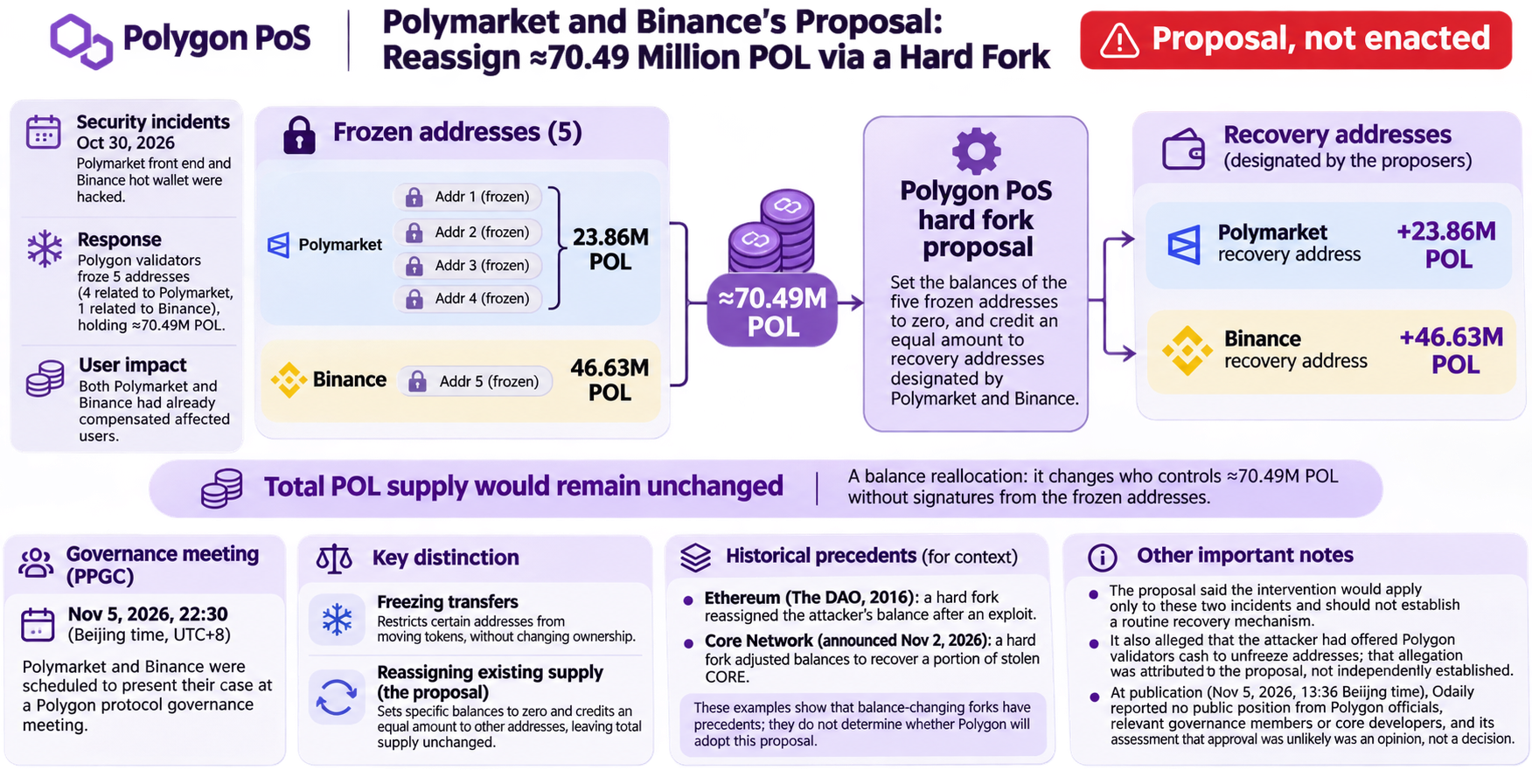
Polymarket and Binance were scheduled to present their case at a Polygon protocol governance meeting at 22:30 Beijing time on November 5, 2026. At publication, Odaily reported no public position from Polygon officials, relevant governance members or core developers. Its assessment that approval was unlikely was an opinion, not a decision.
Odaily compared the proposal with Ethereum’s 2016 fork after The DAO exploit and a Core Network fork announced on November 2, 2026. Those examples show that balance-changing forks have precedents; they do not establish whether Polygon would adopt this proposal. The immediate token-economic distinction is between freezing transfers and reassigning existing supply: the latter leaves total supply unchanged while overriding control of specific balances.
Source: odaily.news (originally published 2026-11-05 13:36 UTC+8)