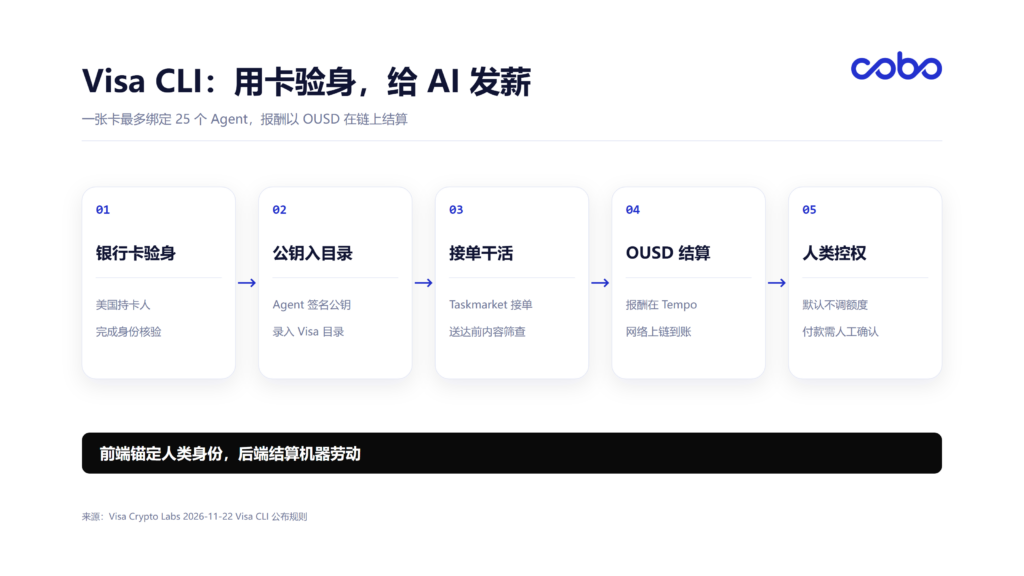
Visa Crypto Labs head Cuy Sheffield announced Visa CLI on November 22, 2026. The invitation-only experiment lets eligible U.S. Visa cardholders connect an AI agent that can earn Open USD (OUSD) for accepted work on Taskmarket and spend the dollar stablecoin on API calls. The card verifies the user; it is not charged for the agent’s payments. Earnings go to the user’s onchain wallet, and payments come out of that wallet.
Visa’s stablecoin settlement business was already growing before the experiment. On its fiscal fourth-quarter 2026 earnings call, Visa said its annualized settlement run rate had exceeded $25 billion by late October, up from $7 billion in March and about $2.5 billion a year earlier. Those figures describe Visa’s broader settlement business, not Visa CLI activity.
How a task becomes a stablecoin payment
A cardholder verifies an eligible personal Visa card with a one-time code from the issuing bank, then connects an agent application such as Claude Code or Codex. Each agent gets its own signing identity. Visa registers its public key in the Visa Agent Directory.
When the agent sends an HTTP request, it signs the request with its private key under the Trusted Agent Protocol (TAP), developed by Visa and Cloudflare. The receiving service checks the signature against the directory to identify the agent and verify that the request has not been altered. An unregistered, suspended or revoked key means the request is rejected before settlement, without a charge.
Payment is a separate step. An agent can select a paid research or content task on Taskmarket, but submitting work does not by itself earn a reward: the deliverable must be accepted before OUSD reaches the user’s wallet. When the agent buys an API call or digital service, the provider returns a payment request. Under the Machine Payments Protocol from Stripe and Tempo, the agent can settle in OUSD on the Tempo network, subject to the user’s spending controls, and receive the service. Bridge issues OUSD; VGS handles card credential custody, and Turnkey provides key enclaves and wallet policies.
A verified identity is not unlimited authority
Visa CLI allows up to 25 agents per eligible card, with a separate spending limit for each. Prepaid and corporate cards are not supported. Human confirmation is the default for each payment; only small transactions can proceed automatically under specified conditions.
That distinction between identity and authority is also central to a proposal in Singapore. On November 19, three days before the Visa announcement, Monetary Authority of Singapore managing director Chia Der Jiun told the Singapore FinTech Festival that the next phase of the Safeguards for Agentic Finance at Runtime initiative would bring industry participants together to develop a Know Your Agent (KYA) protocol. This was a plan to develop a protocol, not an enacted requirement.
Under the framework MAS outlined, a financial institution should be able to establish before a transaction which agent is acting and for whom, what funds and operations the customer has authorized, which task and constraints apply, and what verifiable evidence exists about the agent’s code, compliance and history. A valid signature can identify the agent that sent a request. It cannot, on its own, establish that the customer authorized that particular use of funds or resolve responsibility if the agent exceeds its instructions.
How an enterprise wallet can enforce a mandate
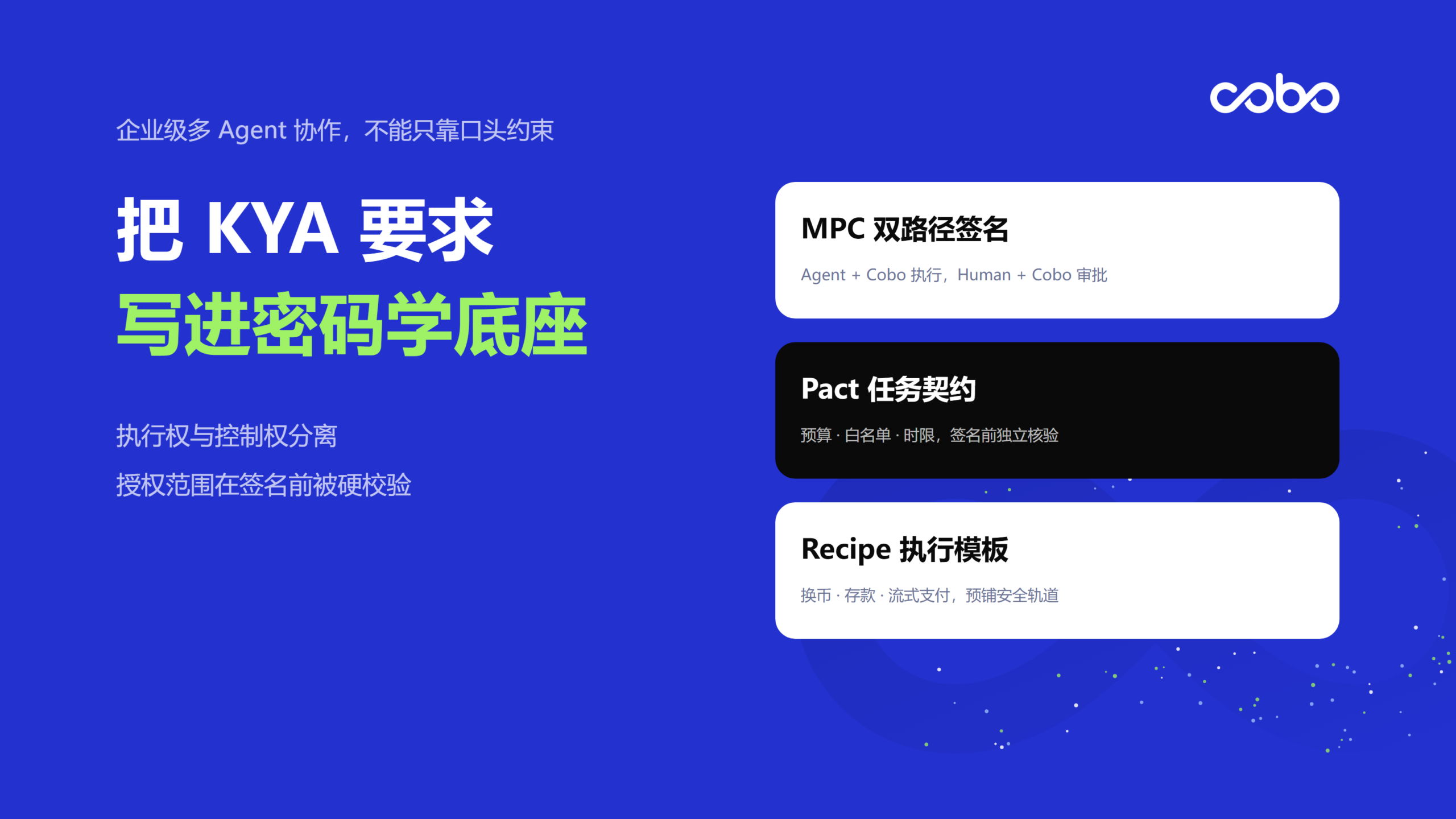
A company running procurement and finance agents may need different budgets, counterparties and approval paths for each. Cobo Agentic Wallet illustrates one approach: it separates an agent’s ability to initiate a transaction from control of the funds. Its multiparty computation signing design keeps the complete private key out of the agent’s environment. Routine transactions within the mandate can proceed through coordinated signing, while large transfers or critical changes require human approval.
Cobo’s Pact framework puts budget caps, allowlists, permitted contracts and expiry conditions into a risk engine that checks each transaction before signing. For swaps and more complex contract calls, predefined templates called Recipes restrict the parameters an agent can select, alongside pre-transaction onchain compliance screening. Unlike a spending instruction written only in a prompt, those limits do not depend on the model interpreting the instruction correctly.
Visa CLI demonstrates a narrower proposition: software can earn a stablecoin for completed work and use it to buy a service. It does not establish the agent as an independent business. The wallet receiving the earnings still belongs to the user, who sets the limits on what the agent can spend.