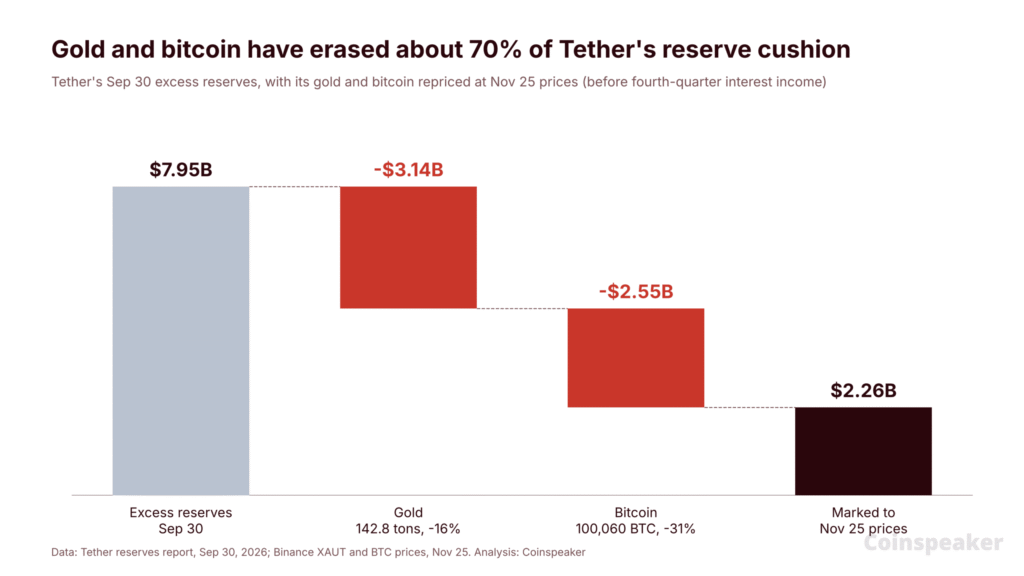
Tether reported $7.95 billion more in assets than liabilities on September 30, 2026. Repricing just two of its USDT reserve holdings, gold and Bitcoin, at November 25 prices would reduce that surplus to about $2.26 billion, according to Coinspeaker’s calculations. The roughly 70% decline is an estimate of the change in excess reserves, not a 70% loss of USDT’s backing or an updated balance sheet from Tether.
Which gold counts toward USDT’s reserves?
Tether’s September 30 reserve report valued its gold bars at $19.08 billion using a price of $4,157.41 per ounce. That implies holdings of about 4.59 million ounces, or 142.8 tons. Using the November 25 price of $3,473 for Tether Gold (XAUT) as a per-ounce benchmark puts the decline in the value of those bars at about $3.14 billion.
A separate 25.7 tons backed XAUT itself. The token’s Ethereum contract showed 827,418 XAUT outstanding on November 25. Each represents one ounce of gold, putting their combined value at about $2.9 billion. Together, the two pools accounted for about 168 tons, but the gold backing XAUT belongs to its token holders. They bear its price changes; those bars do not count toward USDT’s reserve surplus.
Bitcoin accounted for the other $2.55 billion of the estimated decline. Tether held about 100,060 BTC valued at $83,621 each on September 30, compared with a November 25 price of $58,109.
Redemptions and income complicate the estimate
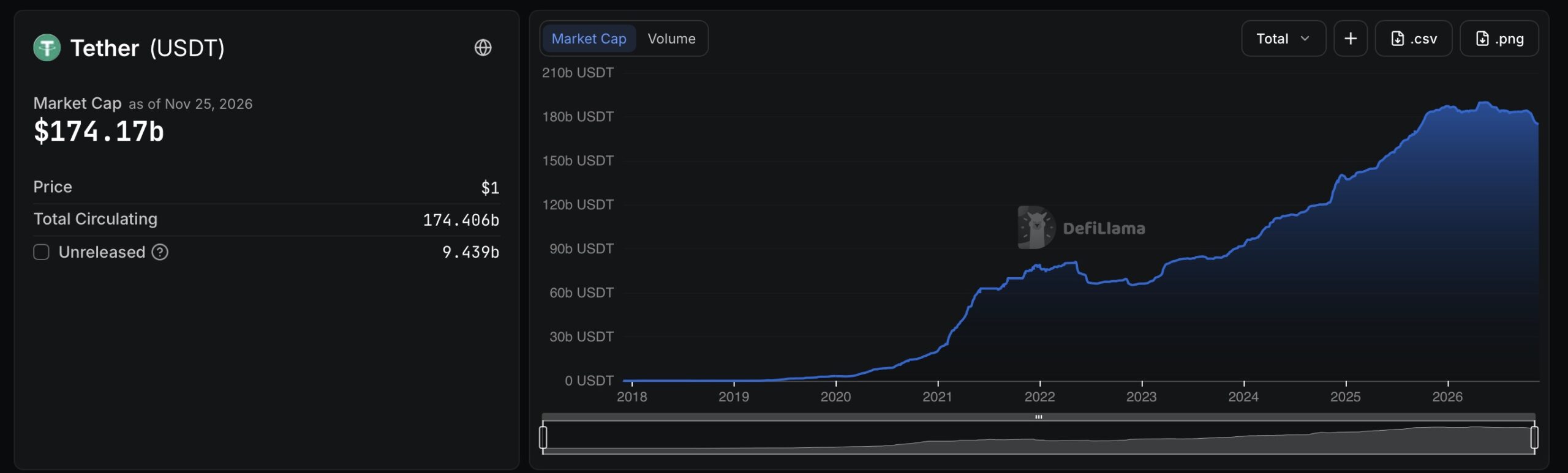
USDT supply stood at $174.4 billion on November 25, down $16 billion from its May 20 peak of $190.4 billion. About $9.4 billion of USDT had been redeemed since September 30, a roughly 5% contraction. Supply fell on most days in November after starting the month at $179.8 billion, according to DefiLlama figures cited in the report.
Redemptions reduce the pool of reserves on which Tether can earn interest. Its September report listed $122.8 billion in US Treasury bills. Fourth-quarter income could offset some of the estimated gold and Bitcoin losses: Tether reported profits of $1.04 billion and $1.5 billion in the first and second quarters of 2026, respectively. Conversely, its $4.18 billion stock portfolio, which the reserve report said included gold and Bitcoin exposure, may also have declined. Neither effect is included in the $2.26 billion estimate.
Gold’s November decline
US gold futures closed at $3,503 an ounce on November 25, down 10% from November 12 and 37% below the January 28 record of $5,589. Silver futures fell 21% over the same November period to $39.58. The dollar and bond yields rose as traders anticipated higher interest rates. Kitco’s November 24 market report put the odds of a Federal Reserve rate increase at its December 8–9 meeting near 95%. That was a market expectation, not a policy decision.
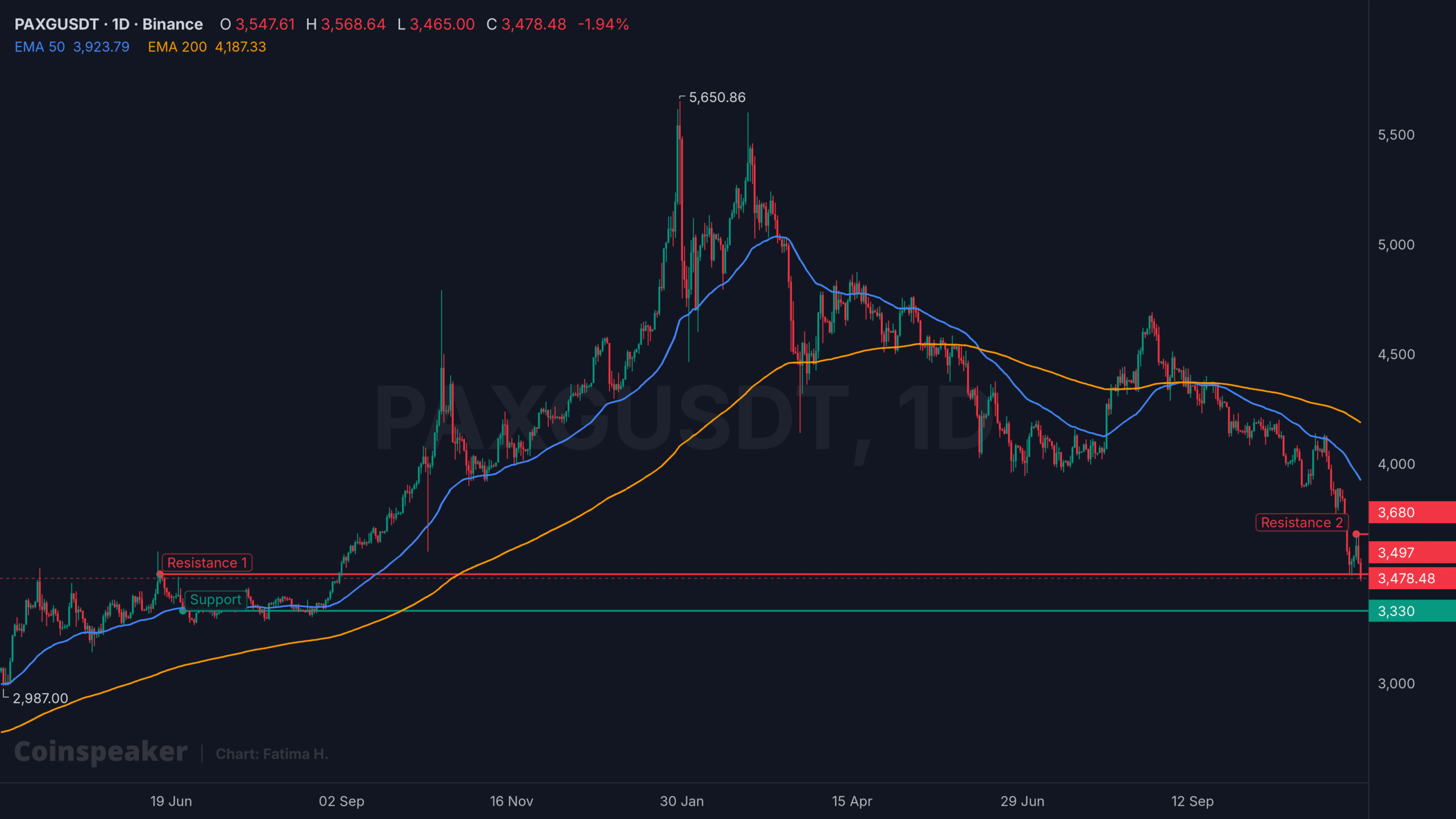
For its chart analysis, Coinspeaker used PAX Gold (PAXG), another token representing one ounce of gold, because its Binance trading history extends further back than XAUT’s March listing. At $3,478, PAXG traded below its 50-day and 200-day exponential moving averages of $3,924 and $4,187. The analysis identified $3,497 as former support: a daily close back above it would put the recent $3,680 high in focus, while a close below $3,465 would bring attention to $3,330, a level that held from June through August 2025. These were conditional chart scenarios, not forecasts of Tether’s reserve value.