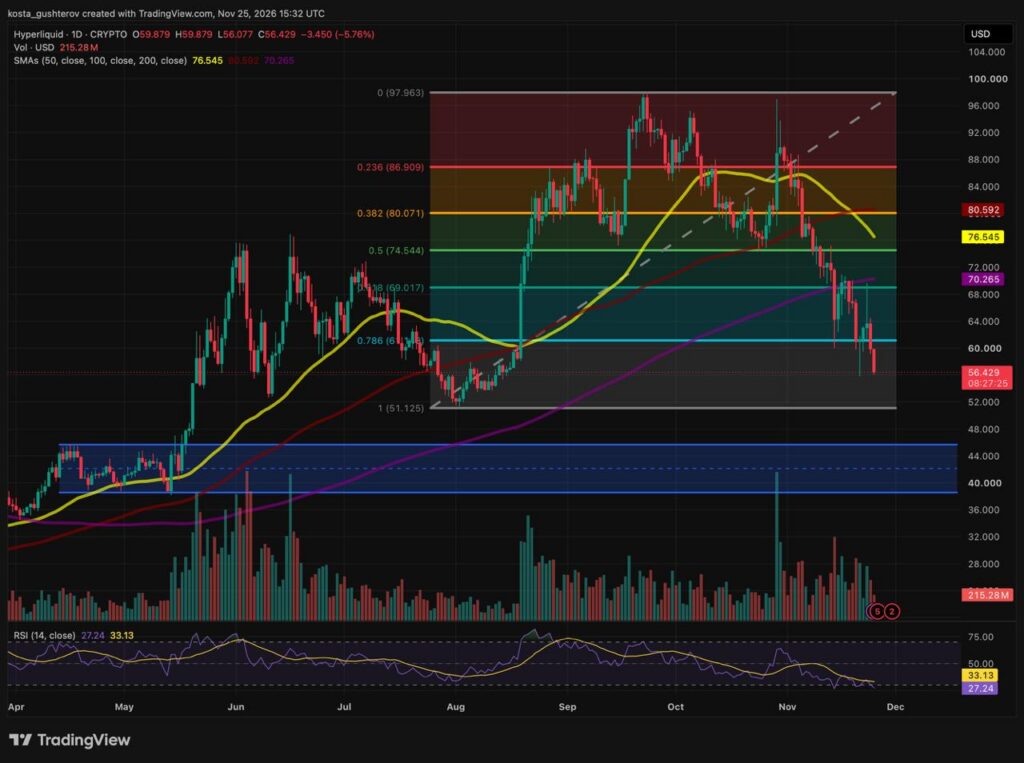
HYPE fell almost 6% to around $56 on Nov. 25, 2026, after opening near $60. Hyperliquid’s trading volume also fell: Blockmetric Research put it at $10.3 billion in the 24 hours to 08:00 UTC that day, down 36.6%. The slowdown matters for HYPE because trading fees fund the exchange’s open-market token purchases.
How trading activity funds HYPE purchases
Almost all of Hyperliquid’s trading fees flow to its Assistance Fund, which buys HYPE on the open market and takes the tokens out of circulation. The fund can keep buying when the price falls, but lower fees leave it with less money to spend. Blockmetric Research reported $2.4 million in net fees for the Nov. 25 window. For comparison, DefiLlama recorded $4.92 million in fees on Nov. 14, the day of the mid-month selloff.
One large contributor to Hyperliquid’s trading volume also left the exchange. On Nov. 25, on-chain analytics firm Lookonchain reported that Abraxas Capital had sold 219,081 HYPE for $13.25 million, then bought 4,230 ETH for $7.09 million. According to Lookonchain, Abraxas withdrew all its funds from Hyperliquid after generating $12.49 billion in perpetual futures trading volume and earning $552.49 million in profit.
Abraxas ran a market-neutral arbitrage strategy. It had been winding down its Hyperliquid accounts since Nov. 16, when Lookonchain linked the firm to API keys leaked on a different exchange, Lighter. The withdrawal was not a directional bet against HYPE, and the figures do not establish that Abraxas caused the price decline.

Scheduled releases are not actual distributions
On the supply side, a Hyperliquid Labs official said on Discord that only 180,000 HYPE from the team allocation would be distributed in early November, versus roughly 9.92 million on the vesting schedule. Tokenomist listed another core-contributor release of about 9.92 million HYPE for Dec. 6. That figure was a scheduled release, not confirmation of how many tokens contributors would receive or sell.

A leveraged position near the August low
The largest open HYPE long held about 1.38 million HYPE at an average entry near $39, using 5x cross margin. Its owner had added $7 million in USDC since Nov. 20. Lookonchain flagged the position as close to liquidation on Nov. 21; after the deposits, Hyperliquid’s account data put its liquidation price near $53. At that price, the position was worth roughly $73 million. A forced close could add selling pressure about $2 above the August low, but no such liquidation was reported.
HYPE had twice failed to hold the $69–$70 area, where the 0.618 Fibonacci retracement met the 200-day simple moving average. It then failed to regain $61, the 0.786 retracement, on a daily close. By Nov. 25, the 50-day average near $77 had crossed below the 100-day average near $81. The 14-day relative strength index had fallen from about 38 on Nov. 19 to 27, below its signal line near 33. Both price and momentum were making lower lows despite the oversold reading.
The nearest reference points for the Nov. 29 weekly close were $61 and the Nov. 21 three-month low near $55. A close above $61 would mark the first weekly recovery of that level since the break. A close below $55 would extend the sequence of lower lows, with the long’s estimated liquidation level near $53 and the August low near $51 below it. HYPE had traded in the low-to-mid $50s for roughly two weeks in August; the earlier $39–$46 range held for about a month before the late-May breakout. Neither trading range guaranteed support.
Separately, Hong Kong’s Securities and Futures Commission added Hyperliquid to its alert list of suspicious virtual asset trading platforms on Nov. 18, saying the exchange was not licensed in Hong Kong.