SBI Solana Global has begun full-scale operations in Japan, SBI Holdings, Sumitomo Mitsui Financial Group (SMFG) and the Solana Foundation announced on November 25, 2026. The three partners completed the agreements restructuring SBI R3 Japan, which now operates under the new name. They first outlined the venture on July 13, when the foundation agreed to take a stake in SBI R3 Japan.
Solana said SBI Holdings and SMFG together have $2.3 trillion in assets and more than 80 million customers. Those figures describe the two financial groups, not capital committed to the venture or customers already using its services.
What the venture plans to build
SBI identified four lines of business. One is stablecoin payments, including micropayments made by AI agents. Two others focus on tokenization: one covers bonds, investment funds and loan receivables; the other covers commodities and other real-world assets. The fourth is on-chain asset management.
The company plans to start in Japan before expanding across Asia and connecting with global on-chain markets. The November 25 announcement marks the start of operations, not the rollout of every planned service.
SBI already has a cross-border crypto payments business through its longstanding relationship with Ripple. It owns around 9% of Ripple Labs and 60% of their joint venture, SBI Ripple Asia. SBI Remit uses XRP for transfers from Japan to the Philippines.
Separately, Binance opened spot trading against USDT for five tokenized exchange-traded funds, known as bStocks, on November 25. One, IBITB, is linked to BlackRock’s iShares Bitcoin Trust. The other four are SOXXB, IGVB, ARTYB and FRHCB.

Bitcoin ETF outflows reach a sixth session
U.S. spot Bitcoin ETFs recorded $231.56 million in net outflows on November 24, their sixth consecutive trading day of withdrawals, according to SoSoValue. U.S. spot Ether ETFs recorded $64.02 million in net outflows that day. CryptoQuant’s Coinbase Premium Index had remained negative for 63 consecutive days, indicating that Bitcoin traded at a discount on Coinbase relative to global exchanges.
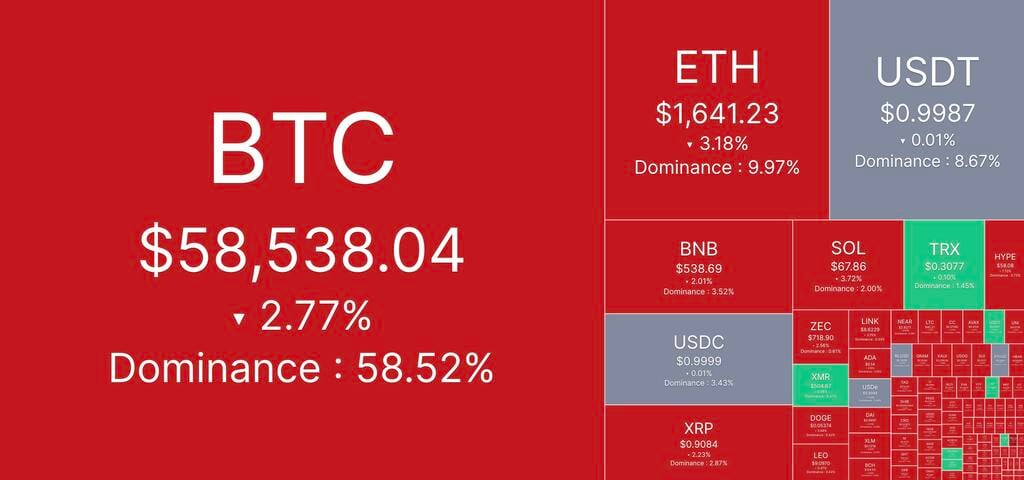
Bitcoin traded near $58,580 on the morning of November 25, down 1.97% over 24 hours, according to TradingView. It had failed to hold above $64,000 earlier in the week after touching $55,150 on November 21, its lowest price since September 2024. Ether fell 3.18% to $1,641 and SOL fell 3.72% to $67.86 over the same 24 hours, according to CoinMarketCap. USDT and USDC together accounted for 12.4% of the crypto market.
Mining data showed a decline over a longer period. Glassnode reported that Bitcoin’s hashrate was down 8% year over year, its first annual decline since China banned mining in 2021. Hashprice, a measure of mining revenue per unit of computing power, reached a record low.
Ether trading diverges by order size
Alphractal CEO Joao Wedson reported that small Ether orders showed net buying while large orders showed net selling. In the cumulative volume delta data he shared on November 25, orders below $1,000 registered $132 million in net buying since the September 21 peak. Orders from $100,000 to $1 million registered $4.29 billion in net selling, and orders above $1 million registered another $2.5 billion. Wedson said he believed a sustained Ether bull market would require larger buyers to return; that was his interpretation, not a forecast established by the data.
Stablecoin reserves, payments and custody
Estimated unrealized losses on Tether’s Bitcoin and gold reserves stood at $4.7 billion, and its excess reserve buffer had shrunk by almost 60% since September 30. Separately, a Bloomberg investigation reported that Tether had asked some hack victims for fees of up to 20% to return frozen USDT.
On November 24, AI project Heurist said agents had made more than 10 million inference payments on the XRP Ledger. According to Heurist, those payments settled in RLUSD through t54’s x402 facilitator.
Ripple also said Turkish bank Yapı Kredi uses Ripple Custody for its Yapı Kredi Kripto platform. Türkiye’s Capital Markets Board approved the bank’s application to operate as a crypto asset custodian in June, according to the bank’s filing on the KAP disclosure platform.