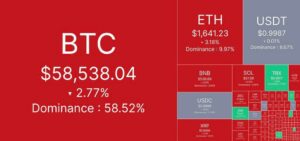
Crypto asset manager 21Shares said a return to $73,000–$75,500 would signal renewed Bitcoin demand only if it came with steady ETF inflows and rising stablecoin balances. The firm set out those conditions in a November 24 research report. CoinCentral reported the findings on November 25, 2026, at 16:23:50 UTC+8.
Bitcoin briefly reached $64,603 on November 23 before giving up the gains and traded near $60,242 on November 24. QCP Group wanted to see two other signs before trusting a rebound: a more stable tech stock market and options-implied volatility below 40.
Why the decline outlasted the initial shock
21Shares identified the $6.4 billion Binance hack on October 29 as the trigger for the decline, but attributed most of the losses to weaker demand and forced selling. Bitcoin fell 5.1% in the two days after the hack, then recovered almost all of that loss to trade at $80,488 on November 4. As demand weakened, it fell 8.3% over the following week to $73,806.
The steepest leg came from November 11 to 14, when Bitcoin fell another 13.5% to $63,821. Over the final three days of that stretch, exchanges closed $1.6 billion in Bitcoin long positions, accounting for 92% of Bitcoin liquidations. When a falling price forces an exchange to close a leveraged bet on a price increase, the closure adds selling pressure.
Across crypto markets, liquidations totaled $5.8 billion in the week ending November 15, with longs accounting for 81%. On November 20, Bitcoin fell 4.9% and another $671.8 million in longs were liquidated.
Stablecoin supply and ETF flows pointed to weaker demand
Stablecoin supply contracted by $10.7 billion after the hack, the largest 18-day decline in dollar terms since Terra collapsed in 2022. Stablecoin balances on exchanges fell 15%. US spot Bitcoin and Ether ETFs recorded a combined $3.9 billion in net withdrawals from October 30 through November 13. SoSoValue data showed a further $569.74 million in withdrawals from spot Bitcoin ETFs in the session before November 24.
Large holders did not appear to be driving the selling. As of mid-November, the stolen 18,270 BTC and 522,409 ETH had not moved. Neither the US government nor the Mt. Gox trustee had sent Bitcoin to exchanges since the attack, while Strategy added 2,332 BTC between October 26 and November 15. Miner transfers to exchanges reached their lowest level since at least 2020, although the data may not capture sales by publicly traded miners.
Eliezer Ndinga, global head of research at 21Shares, said the market was already fragile before the hack. The Federal Reserve had raised rates in September, core inflation had risen 0.3% for a third consecutive month, and doubts about AI spending had kept the Nasdaq-100 below its October 6 record. Ndinga said a larger-than-expected December rate increase could extend the downturn. The stolen BTC and ETH, valued at $2.2 billion, could also reach the market through over-the-counter brokers in the coming months; the report did not say those sales had occurred.
What the $53,250 benchmark measures
21Shares identified $53,250 as the next downside level to watch, not a price floor. According to Glassnode data, that was Bitcoin’s realized price on November 22, an estimate of holders’ average cost basis. Bitcoin closed below its realized price in each of the four major bear markets the firm tracked. At the lowest daily close, the gap narrowed from 61% in 2011 to 24% in 2022.
Extrapolating from that pattern, 21Shares outlined a lower-probability scenario of $43,800, about 18% below the November 22 realized price. The firm cited spot ETFs and institutional buyers as reasons it considered such a decline less likely.
21Shares judged Bitcoin to be more than a year into a cyclical bear market. The past downturns it examined lasted about two and a half years, with price declines averaging 84%. Its outlook was for an uneven recovery in which Bitcoin, round-the-clock trading venues, privacy protocols and quantum-resistant solutions would fare better than the broader market.