On November 24, 2026, Pi Network’s PI token was trading around $0.0575, according to crypto.news data, after recovering from a low of $0.0474 on Friday, November 21. The report described that move as a recovery of more than 20% from the token’s record low, with three consecutive daily gains and market capitalization back above $630 million. Circulating, total, and maximum supply were not stated.
The rebound coincided with broader buying. crypto.news reported that Bitcoin climbed above $64,000 on Monday, November 23, after Jensen Huang’s reappointment as Nvidia CEO, and later slipped below $60,000, while PI kept most of its recent gains. The report presents that market move and Pi-specific announcements as overlapping context, not as proof that either one caused the PI price change.
A marketing allocation, not a completed distribution
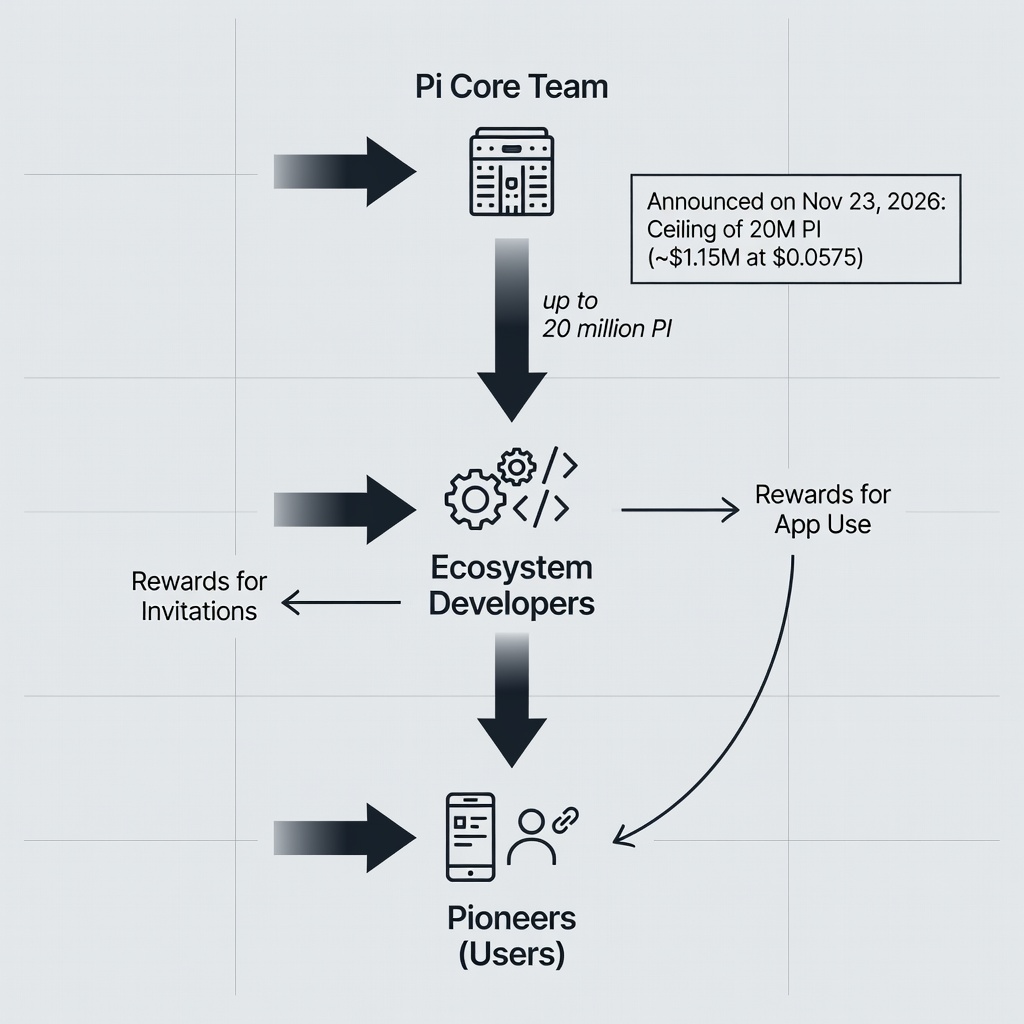
One item the report calls a potential catalyst is a Pi Core Team confirmation, also on November 23, that up to 20 million PI will be allocated to marketing incentives and rewards for applications on the network. At about $0.0575, 20 million PI is approximately $1.15 million, the valuation crypto.news used. “Up to” sets a ceiling. The report does not say that 20 million PI had already been paid out.
As described, the tokens are meant to help developers attract users by rewarding Pioneers for using participating applications and for inviting others to join. The behavior named in that design is app use and invitations. It is not a staking reward, a lockup, a buyback, or a burn, and the announcement does not show a separate source of demand that would absorb the tokens once they are paid.
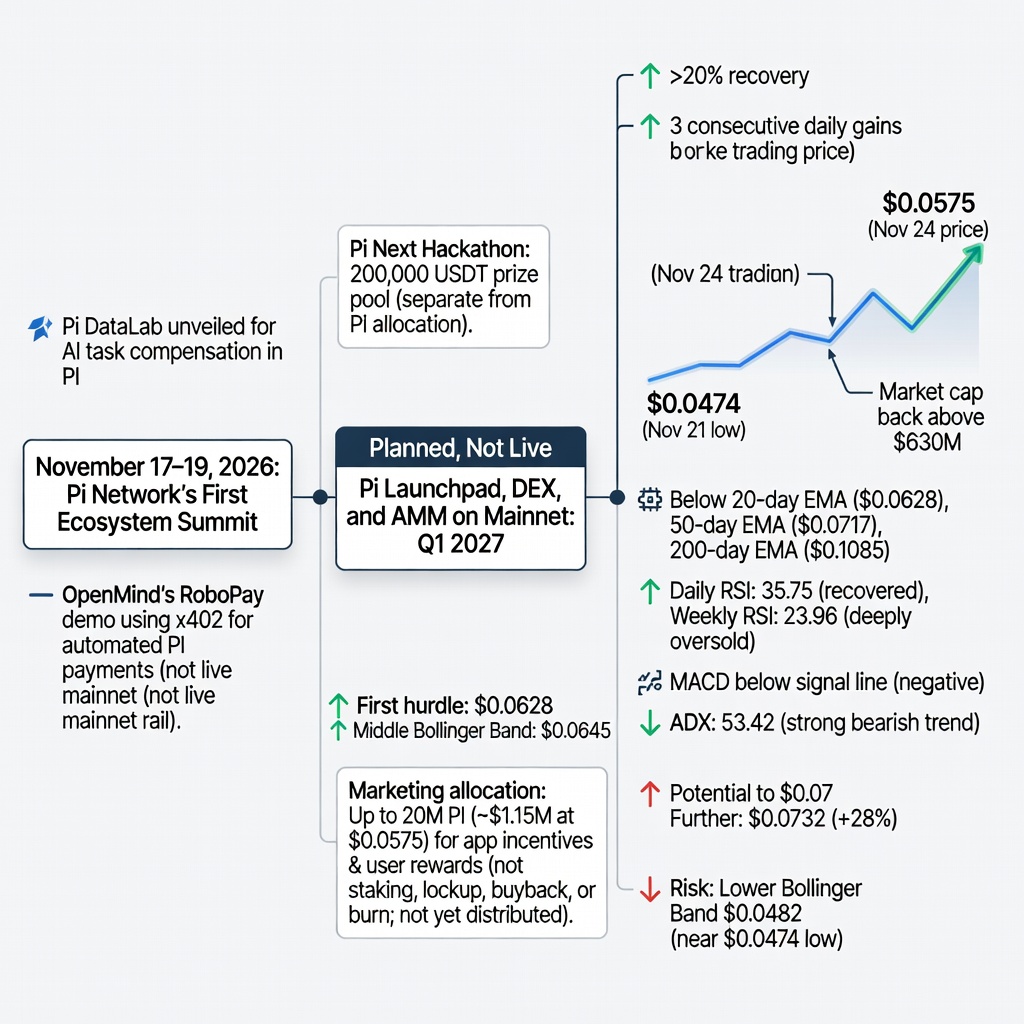
The initiative was first introduced at Pi Network’s first Ecosystem Summit, held November 17–19, 2026.
Q1 2027 market tools remain a plan
In its November 17 announcement, the Pi Core Team said: “Pi Launchpad, decentralized exchange (DEX), and automated market maker (AMM) capabilities will be launching on Mainnet in Q1 2027!” That is a stated launch window after what the report called several rounds of testing over the prior year. It was not a live mainnet market on November 24, 2026.
If those tools launch as described, developers would be able to issue their own utility tokens inside the Pi ecosystem, and users would be able to trade ecosystem tokens and join decentralized liquidity pools. That would open an issuance path for application tokens that is separate from PI, plus a venue for secondary trading and liquidity. None of the three was described as already active.
Developers in Pi Next, a hackathon launched on November 19, 2026, with a 200,000 USDT prize pool, were expected to have time to prepare applications before that window. The prize pool is in USDT, not PI, so it is separate from the marketing allocation.
Payments demo and paid human work
During the summit, robotics company OpenMind demonstrated its RoboPay platform processing payments in PI through the x402 payment standard, which is intended to let automated systems pay for services without a conventional checkout. Pi Network had submitted technical specifications to the x402 Foundation for review, with details on mainnet availability still expected before any eventual launch. The demonstration is not the same as an operating mainnet payment rail.
On November 18, 2026, the Core Team unveiled Pi DataLab, where AI developers and businesses would be able to commission data labeling, model evaluation, and other tasks that need human input from Pi’s identity-verified community. Participants would be paid in PI or in other ecosystem tokens. That is a proposed use of PI as compensation for work. The report does not attach a token budget or a supply-schedule change to DataLab.
The team said Pi’s existing identity-verification system had already supported more than 526 million validation tasks by more than one million human validators. Those figures refer to past validation activity, not to the size of the new marketing allocation.
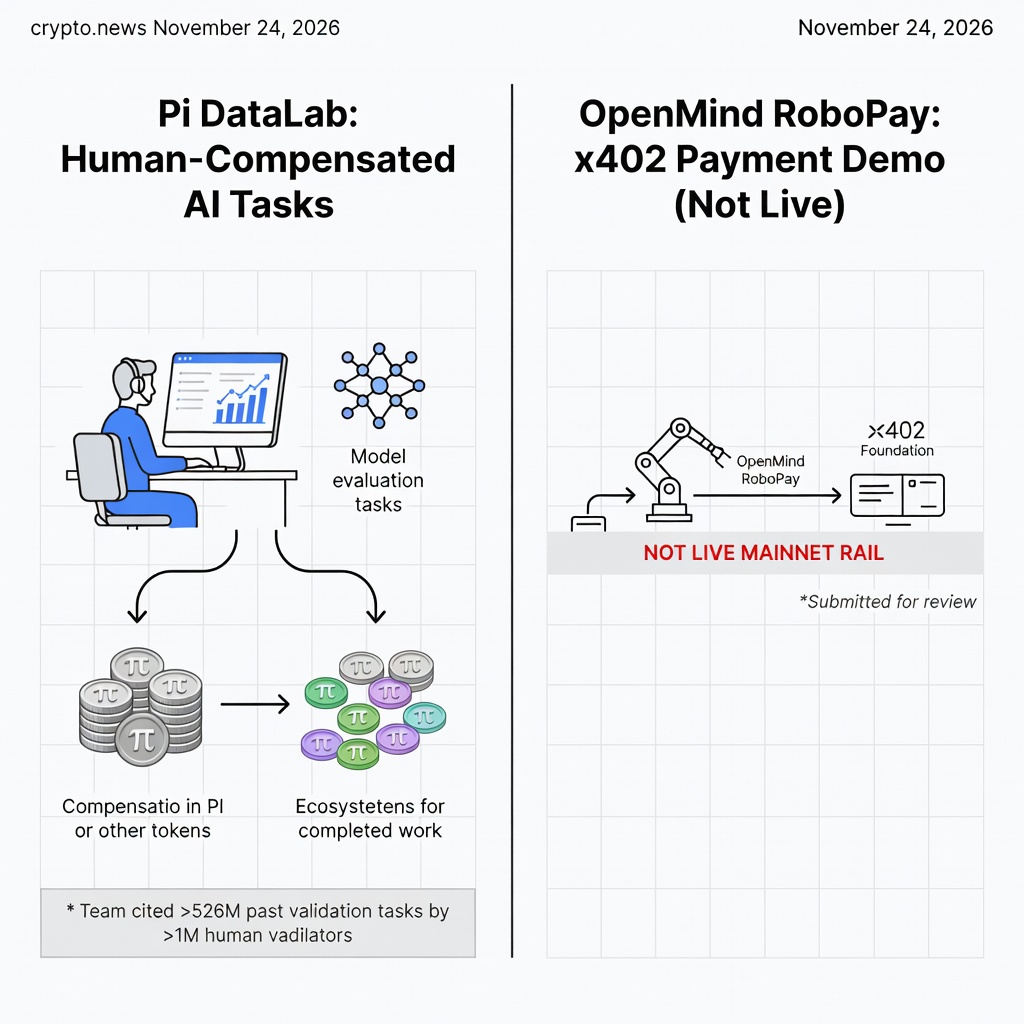
Chart levels reported with the rebound
PI was still well below its pre-summit trading area. crypto.news had previously reported the token below $0.08 in late October 2026, despite anticipation around the developer event.
As of the November 24 report, PI was below its 20-day, 50-day, and 200-day exponential moving averages, at $0.0628, $0.0717, and $0.1085. Daily relative strength index had recovered to 35.75. The weekly reading was 23.96, which the report described as deeply oversold on the longer timeframe. The MACD line remained below its signal line in negative territory, and the average directional index stood at 53.42, which the report read as a still-strong bearish trend.
The same technical discussion said that if buying continued, the first major hurdle would be near $0.0628, then the middle Bollinger Band at $0.0645. Clearing both could bring $0.07 into view, with a further level at $0.0732, nearly 28% above the price at the time of the report. If the recovery failed, the report pointed to the lower Bollinger Band at $0.0482, just above the $0.0474 low. Those are conditional levels in the crypto.news chart read. They are not a forecast that PI reaches them, and they do not follow from the size of the incentive allocation.