
A Four Pillars analysis reported on November 23, 2026, found that revenue-sharing mechanisms did not necessarily offset growth in circulating token supply. Of 83 tokens selected using DefiLlama data, 66 had rules for returning some protocol revenue to holders. Only 16 of those 66 had a positive net accrual yield over the preceding 12 months, according to the study.
The sample focused mainly on protocols with at least $10 million in annualized revenue or at least $1 million returned to holders. Four Pillars said 76% of the return mechanisms had been introduced in 2025 or later.
What the mechanisms do
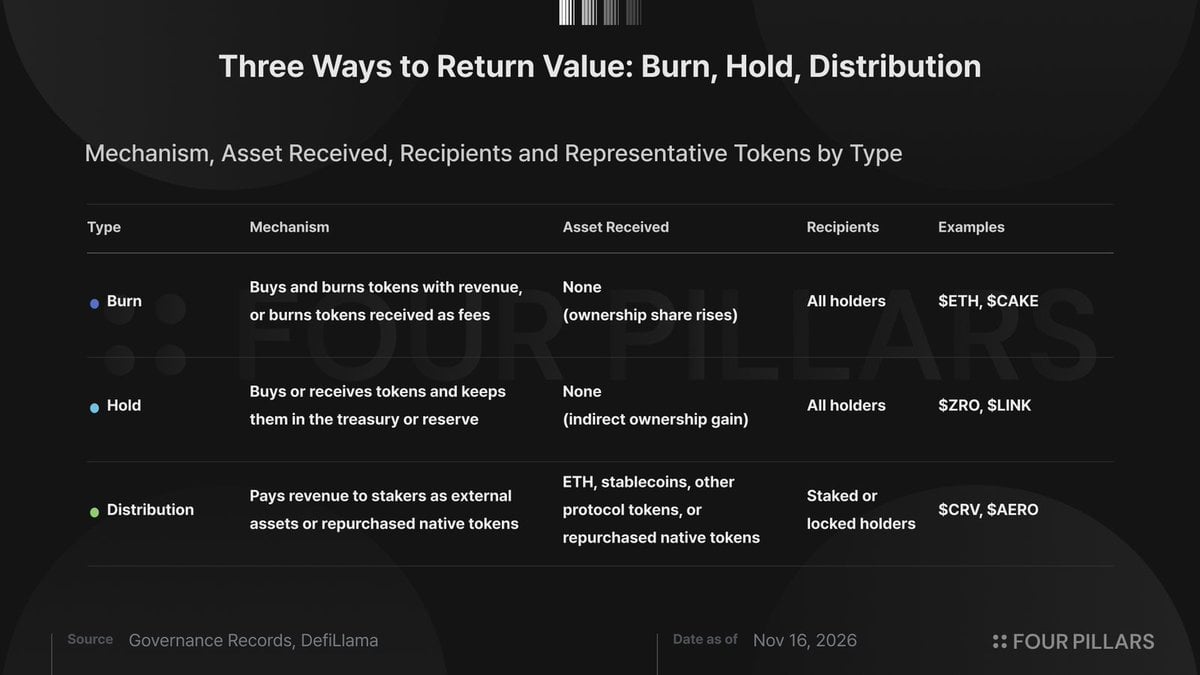
Four Pillars grouped the rules into three types:
- Burn: A protocol buys back and destroys tokens, or burns tokens received as fees. Holders receive no direct payment, but the token supply is reduced.
- Hold: A protocol acquires or receives its token and keeps it in a treasury or reserve. Holders receive no direct payment; the tokens could be used or sold later, depending on future decisions.
- Distribution: A protocol pays revenue or repurchased tokens to eligible stakers or locked-token holders, rather than to every spot holder.
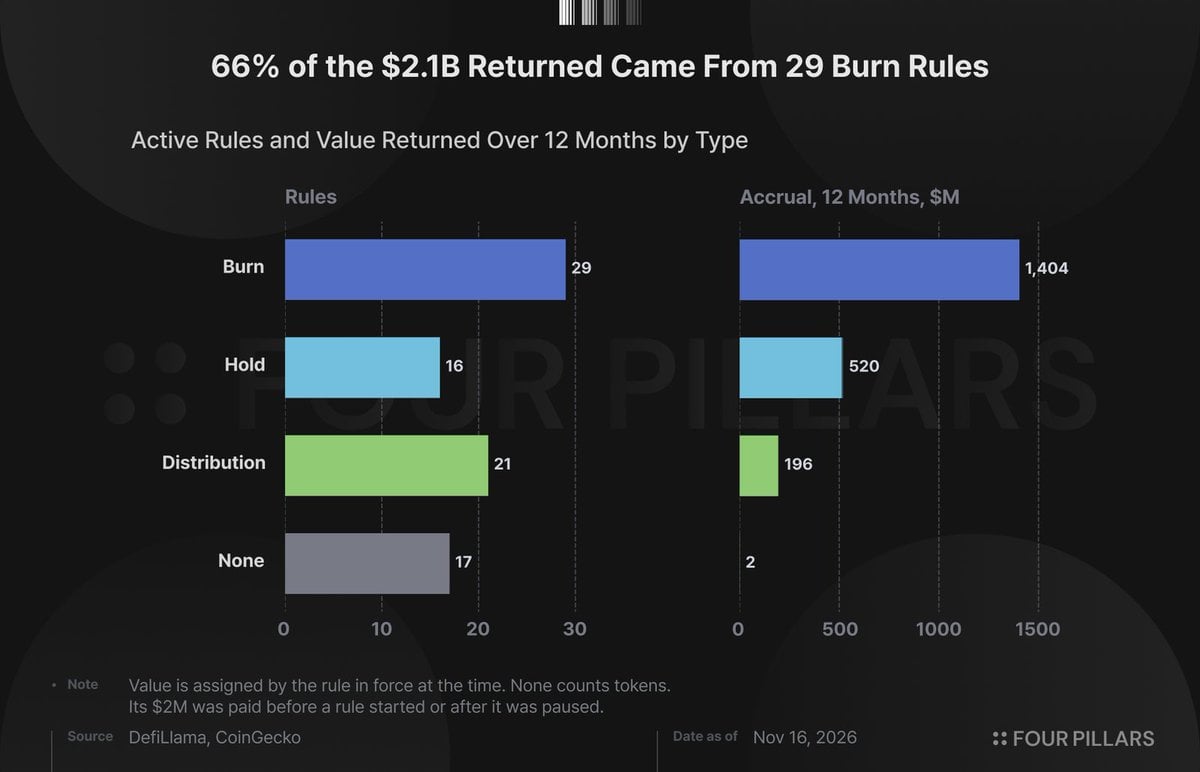
The study counted 29 tokens with burn rules, 16 with treasury-holding rules and 21 with distribution rules. A protocol can use more than one mechanism: Four Pillars cited Sky, formerly MakerDAO, as an example.
Burns dominated the dollar totals
Protocols in the study returned approximately $2.12 billion in value over the preceding 12 months. Buybacks and burns accounted for $1.404 billion, or 66% of that total. Four Pillars attributed 76% of the burn total to three protocols: Hyperliquid ($602 million), Tron ($333 million) and Pump.fun ($133 million). Distribution accounted for $196 million.
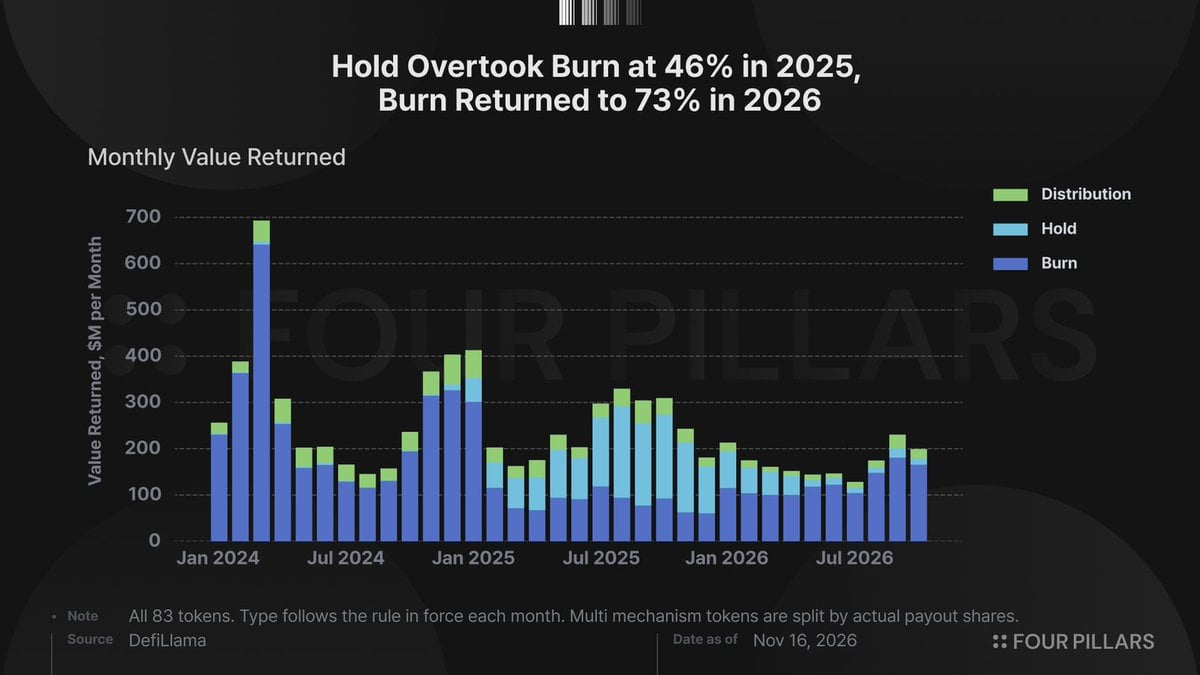
That concentration limits what the aggregate figure says about the mechanism itself. The study’s interpretation was that burns dominated largely because several high-revenue protocols chose to burn tokens—not because burning was shown to be inherently more efficient at delivering value to holders.
The supply-growth test
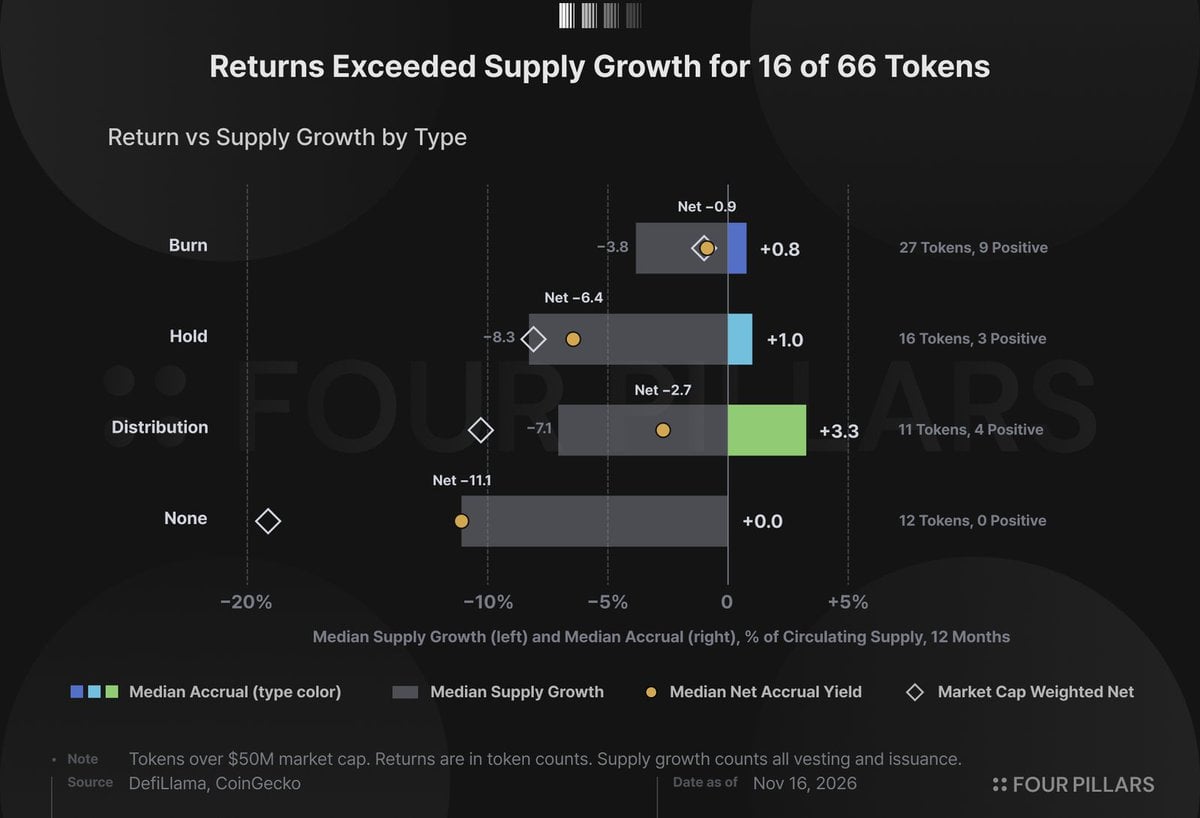
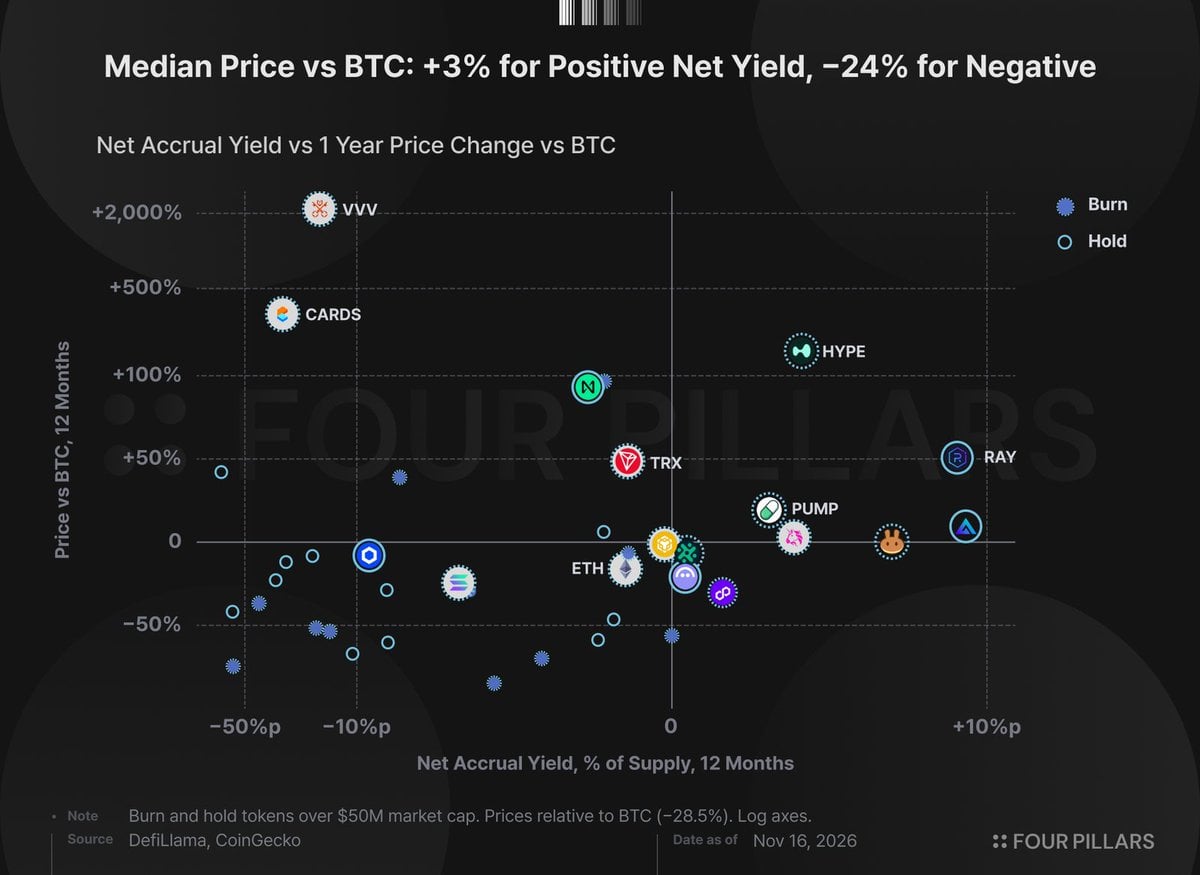
Four Pillars defined net accrual yield as the nominal rate of value returned over 12 months minus the percentage increase in circulating supply over the same period. Under this measure, token releases can outweigh buybacks or distributions even when the protocol returns substantial revenue.
Among 27 burn tokens included in this calculation, nine had a positive net accrual yield. The group’s median was −0.9%. The median was −6.4% for treasury-holding tokens and −2.7% for distribution tokens, compared with −11.1% for tokens without a return mechanism. These figures describe the study’s samples, not a guaranteed outcome for any mechanism. Distributions also require care in interpretation: newly issued native tokens are not the same as a payout funded by protocol revenue.
A limited link to price
In the study’s 12-month comparison, the 16 tokens with positive net accrual yield had a median price performance of +3% relative to BTC; tokens with negative net accrual yield had a median of −24% relative to BTC. Yet across 39 tokens using burn or hold mechanisms, Four Pillars calculated a Spearman correlation of just +0.29 between net accrual yield and one-year performance relative to BTC—a weak positive relationship, not evidence that a return mechanism will lift a token’s price.
The practical distinction is between a protocol returning value and a holder retaining a larger economic claim after supply growth. Evaluating either requires looking at circulating-supply changes alongside revenue and the specific rules governing who receives a benefit.