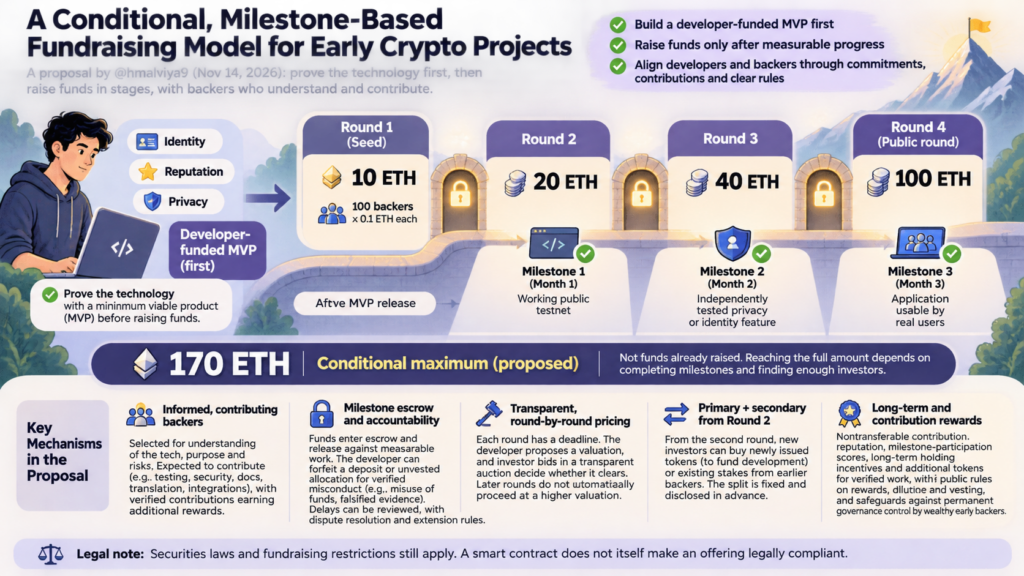
In a proposal published on November 14, 2026, @hmalviya9 argued that an early crypto project should prove its technology before raising funds or broadly distributing a token. The suggested starting point is a developer-funded minimum viable product addressing identity, reputation or privacy. Only after releasing that product would the developer seek an initial 10 ETH.
Start with 100 informed backers
The proposed seed round would admit 100 people contributing 0.1 ETH each. Selection would depend on their understanding of the technology, its purpose and its potential failure points—not a whitelist lottery, influencer connections or speed. Their stakes would be nontransferable during the first milestone period, except under predefined exit or refund rules.
The proposal also asks backers to contribute work, such as testing, finding security flaws, writing documentation, translating interfaces or helping with integrations. Verified contributions could earn additional rewards. Someone who accepts a specific task but fails to deliver could lose a separately staked commitment deposit, not their entire investment.
Release funding against measurable work
The first 10 ETH would enter milestone escrow rather than go to the developer all at once. @hmalviya9 offered a three-month illustrative roadmap: a working public testnet in month one, an independently tested privacy or identity feature in month two, and an application usable by real users in month three.
A founder deposit or unvested token allocation could be forfeited for objectively verified misconduct, such as misuse of escrowed funds or falsified milestone evidence. Missing a deadline because the work proved difficult would not automatically trigger forfeiture; the proposal calls for review, dispute resolution and clear extension rules.
Its four conditional fundraising stages are:
| Stage | Proposed raise |
|---|---|
| After MVP release | 10 ETH |
| After the first monthly milestone | 20 ETH |
| After the second monthly milestone | 40 ETH |
| After the third monthly milestone, in a public round | 100 ETH |
The 170 ETH total is a proposed maximum, contingent on completing milestones and finding enough investors. Each round would have a deadline. The developer would propose a valuation, while investor bids in a transparent auction would determine whether that price clears; later rounds would not automatically proceed at a higher valuation.
From the second round onward, new investors could buy either newly issued tokens that fund development or existing stakes offered voluntarily by earlier backers. The split between primary issuance and secondary sales would be fixed and disclosed before each round. This would offer an exit only where buyers exist, without requiring the project treasury to fund it.
The proposal also considers nontransferable contribution reputation, milestone-participation scores, long-term holding incentives and additional tokens unlocked for verified work. It says reward rules, dilution and vesting schedules should be public before the first contribution, with safeguards against wealthy early backers permanently controlling governance.
@hmalviya9 sketches ERC-20 tokens, ERC-721 or ERC-1155 participation credentials, reputation infrastructure where applicable, account abstraction, escrow, challenge periods and forfeiture rules as possible building blocks—not an implemented system. The public round would come last, after a usable product, testing and real adoption. The author also cautions that securities laws and fundraising restrictions would still apply: a smart contract does not itself make an offering legally compliant.