
Ethereum developers scheduled Glamsterdam for activation on the Hoodi testnet at 19:12 UTC on December 15, 2026, at epoch 143616. At their November 26 consensus-layer meeting, developers reached what the meeting summary called a “rough consensus” to keep the proposed gas charges for creating permanent blockchain data. As of publication at 06:24 UTC on November 27, 2026, Ethereum had not set a mainnet activation date.
What contract creators would pay
EIP-8037 would account separately for the gas used to execute transactions and the gas used to create permanent blockchain data, known as state. The existing base charge for creating a contract is 32,000 gas. Under the proposal, creation would cost 183,600 units of state gas alone, with separate charges for execution and bytecode storage.
The proposal’s authors cited growth in the amount of data Ethereum adds each day: after the block gas limit rose from 30 million to 60 million units, average daily state growth increased from approximately 105 MiB to 326 MiB. On Sepolia, where Glamsterdam activated on October 6, developers began testing a 200 million gas limit alongside changes to block production and transaction processing. Consensus-layer developers also agreed on a way to validate execution payloads through pull request 5770 without introducing consensus-breaking changes.
Fixed gas budgets dominate compatibility findings
Developers postponed Hoodi’s original October 26 activation after security researchers identified contracts that might not work under the proposed charges. An assessment by the Ethereum Foundation, ChainSecurity and Dedaub produced 200 compatibility findings: three high severity, 30 medium and 167 low. Fixed gas budgets accounted for 182 findings, or 91%. Configuration changes could address most issues, but 24 required a contract upgrade or migration.
The audit count is distinct from the estimated number of contracts at risk. Ethereum Foundation developer Marius van der Wijden estimated that 10,000 to 15,000 of Ethereum’s roughly 90 million contracts could encounter problems. The foundation contacted more than 50 potentially affected companies to assess how much time they needed for fixes.
Hegotá priorities remain open
For the subsequent upgrade, Hegotá, Ethlabs researcher Caspar Schwarz-Schilling argued for reconsidering Fork Choice-Enforced Inclusion Lists (FOCIL) and directing resources toward quantum-resistant cryptography. FOCIL would limit block builders’ ability to exclude eligible transactions. Other participants argued that both projects could proceed in parallel. Developers planned to revisit Hegotá’s scope at their next consensus-layer meeting in two weeks.
In a November 24 publication, Ethereum Foundation researcher Kev Wedderburn proposed Keccak-256 as a common hash function for post-quantum infrastructure, citing the extent of its security research. At Devcon in Mumbai, researcher Justin Drake outlined late 2028 as a target, not a deadline, for Ethereum’s post-quantum and post-AI security transition.
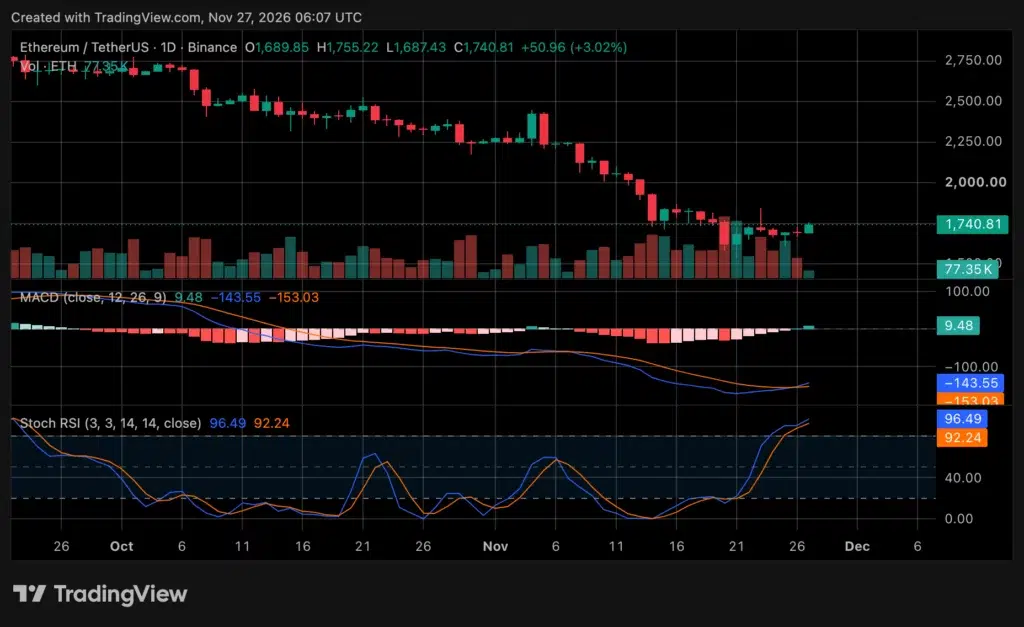
ETH trades back above $1,700
ETH rose 3% over 24 hours to $1,740 on November 27, outperforming Bitcoin during a broader market recovery. It traded between $1,670 and $1,750 and remained approximately 65% below its August 2025 high of $4,950.
Ethereum’s daily price chart showed the MACD line at −143.55, above its signal line at −153.03. The histogram had turned positive at 9.48, but both lines remained below zero. The stochastic RSI readings of 96.49 (%K) and 92.24 (%D) were both above the conventional overbought threshold of 80. The chart analysis identified resistance near $1,750, followed by $1,800–$1,850 and $2,000, and support near $1,667, $1,600 and $1,500.