As reported on November 19, 2026, Pearl’s FP8 upgrade had gone live on its testnet the previous day. The upgrade aims to make it easier for AI inference providers to earn PEARL block rewards from computations they already perform for customers. Whether those rewards will attract genuine inference work remains unproven.
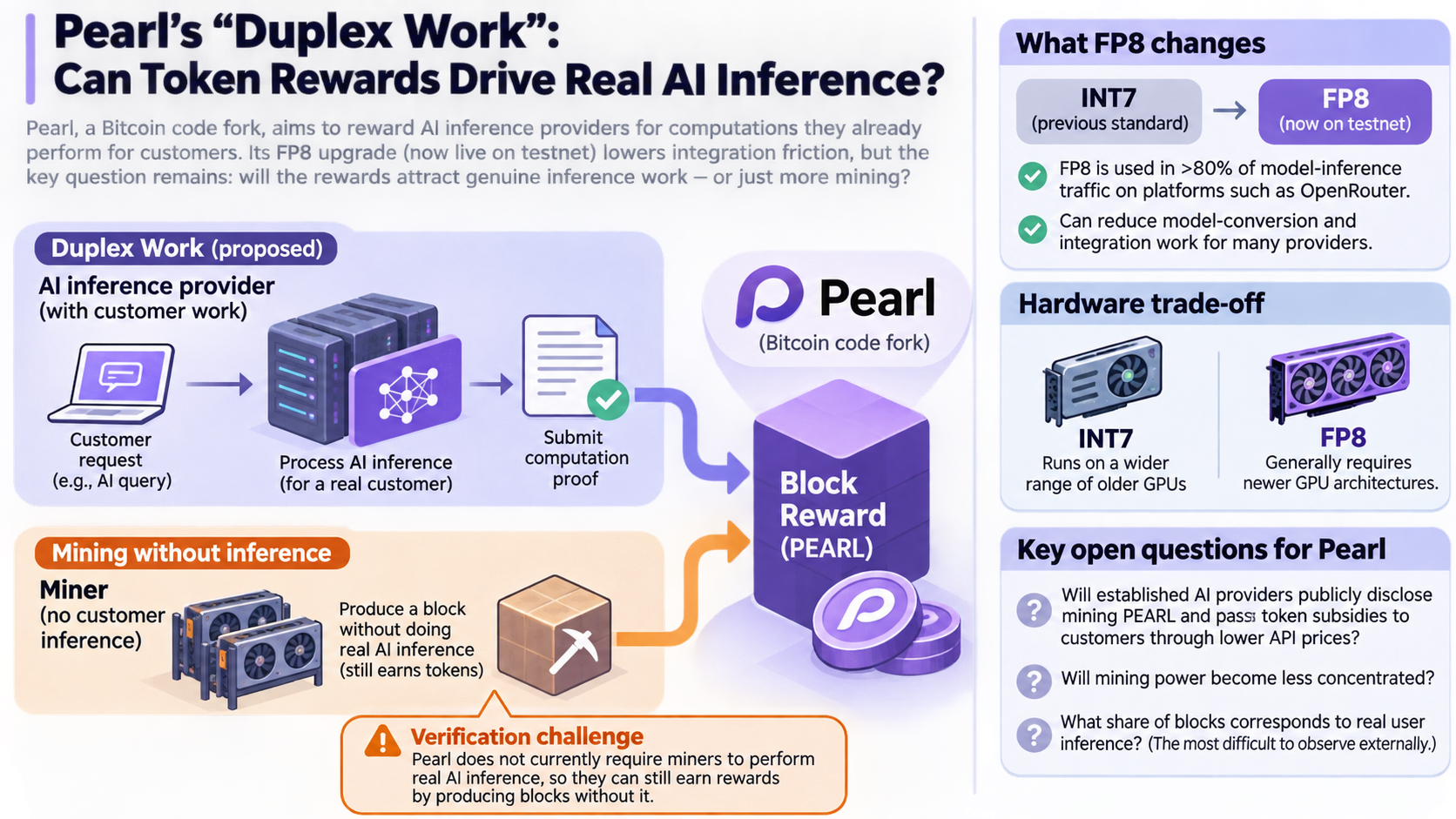
Pearl is a Bitcoin code fork built around a mechanism it calls Duplex Work. Under the proposed model, an inference provider could submit proof of its computations to earn block rewards. But the source notes a central incentive problem: Pearl does not currently require miners to perform real AI inference. Miners can still earn tokens by producing blocks without it.
What FP8 changes
Pearl’s previous mining standard supported INT7, requiring providers using other model formats to convert them before participating. The testnet upgrade moves the standard to FP8. The original report says more than 80% of model-inference traffic on platforms such as OpenRouter uses FP8, so the change could reduce integration work for some providers.
That trade-off has a hardware cost: the report says INT7 can run on a wider range of older graphics cards, while FP8 generally requires newer GPU architectures. Nor does the format change establish that rewarded computations serve real customers; the report says further on-chain verification would be needed to address that problem.
The token-economy question
The report identifies three tests for Pearl’s incentive model: whether established AI providers publicly disclose mining PEARL and pass token subsidies to customers through lower API prices; whether mining power becomes less concentrated; and what share of blocks corresponds to real user inference. It notes that the last measure is particularly difficult to observe externally.
Crypto researcher hitesh.eth disputes the premise that token rewards will draw substantial Bitcoin mining capacity into AI services. He argues that high token inflation could support short-term mining returns without sustaining the model, and alleges that coordinated influencer marketing has amplified the upgrade narrative. Those are his assessments, not established findings about miner migration or product adoption. The report provides no PEARL inflation rate or supply schedule with which to quantify that concern.
PEARL had risen over the preceding week, according to the report, which also pointed to listings on Coinbase and Bybit. Price activity and exchange access, however, do not answer the mechanism’s central question: whether block rewards are paying for useful AI inference rather than merely attracting mining activity.