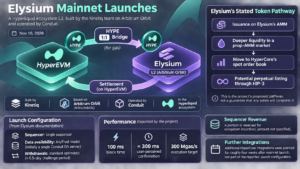
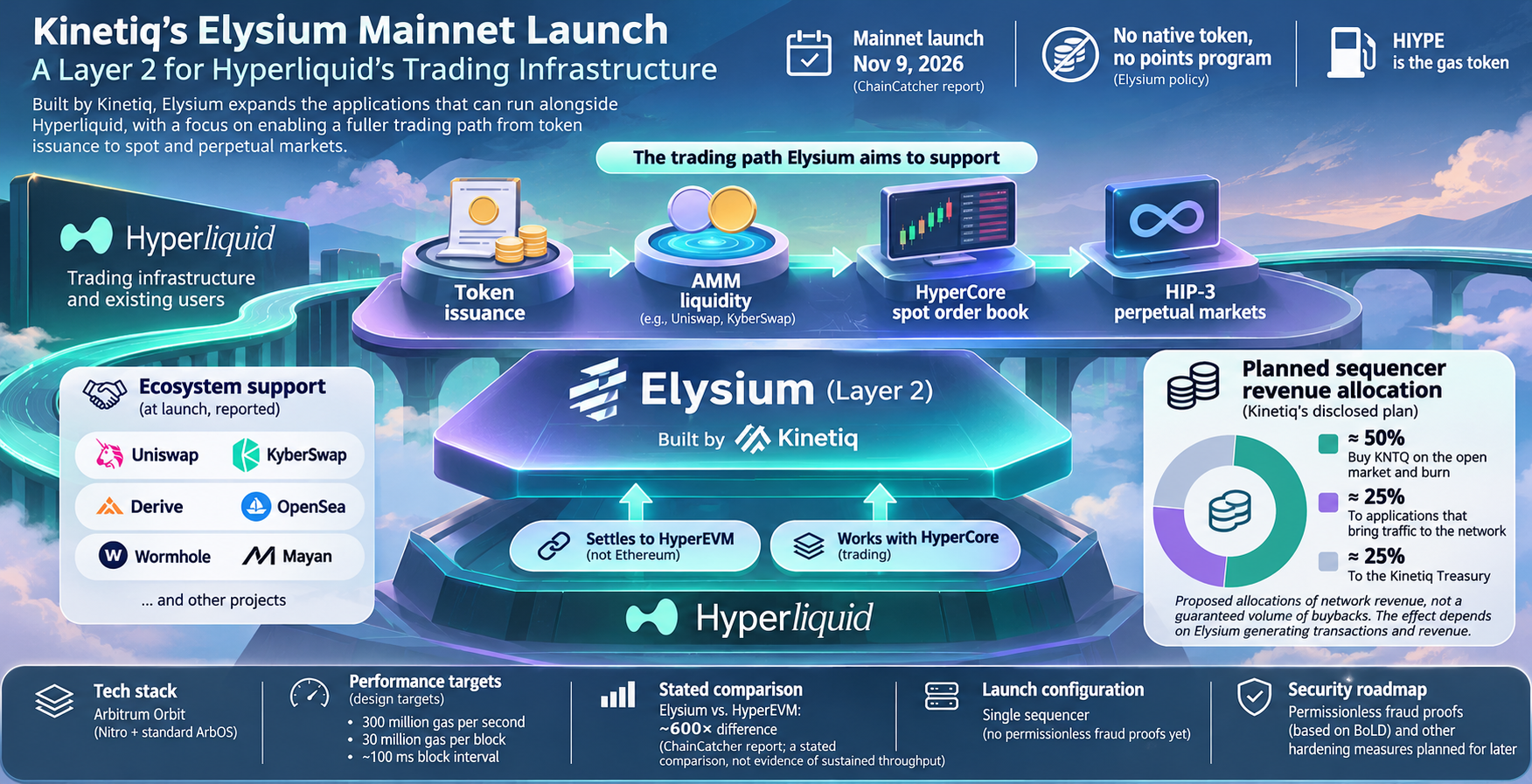
Kinetiq’s Elysium Layer 2 launched its mainnet on November 9, 2026, according to a report published that day by ChainCatcher. The network is intended to expand the applications that can run alongside Hyperliquid’s trading infrastructure. Its token-economy design is notable for what it does not introduce: Elysium says it has no native token or points program. HYPE is its gas token.
Where network revenue is meant to go
Under the plan disclosed by Kinetiq, approximately 50% of sequencer revenue will be used to buy KNTQ on the open market and burn it. About 25% will go to applications that bring traffic to the network, with the remainder entering the Kinetiq Treasury. These are proposed allocations of network revenue, not a guaranteed volume of buybacks. Their effect depends on Elysium generating transactions and revenue.
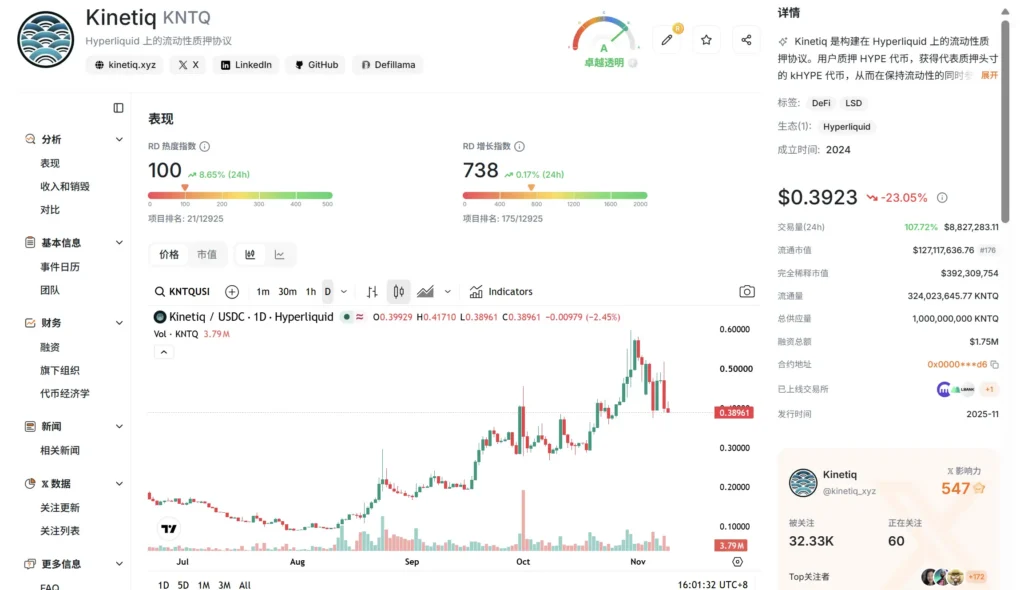
The design gives HYPE a role in paying for network activity, while tying a portion of sequencer revenue to KNTQ and rewarding applications for attracting usage. ChainCatcher reported that KNTQ rose as much as 30% on the day the news was announced; that price move does not establish how much revenue the network will earn.
The trading path Elysium aims to support
Kinetiq, which issues the liquid-staking token kHYPE, built Elysium to draw on Hyperliquid’s existing users and trading infrastructure. The intended path runs from token issuance and AMM liquidity to the HyperCore spot order book and HIP-3 perpetual markets. Whether that path increases sustained spot activity remains an open question.
Elysium uses Arbitrum Orbit technology and settles to HyperEVM rather than Ethereum. Its stated targets are 300 million gas per second, 30 million gas per block and a canonical block interval of roughly 100 milliseconds. ChainCatcher reported Elysium’s comparison of those targets with HyperEVM’s roughly 30 million gas per 60 seconds as a 600-fold difference; the figures are design targets and a stated comparison, not evidence of sustained real-world throughput.
The launch configuration uses a single sequencer. Permissionless fraud proofs based on BoLD, along with other hardening measures, were listed for later implementation. That distinction matters when assessing the network’s launch-stage security assumptions.
Uniswap, KyberSwap, Derive and other projects were among those reported as supporting Elysium. ChainCatcher also noted a concentration of launchpads and meme-token infrastructure among early projects, raising the question of whether initial token creation will translate into durable spot-market activity.
Finally, Elysium’s no-token, no-points policy should not be confused with tokens created by applications on the chain. The report says Elysium officials warned that purported Elysium-token presales and points claims are suspicious.