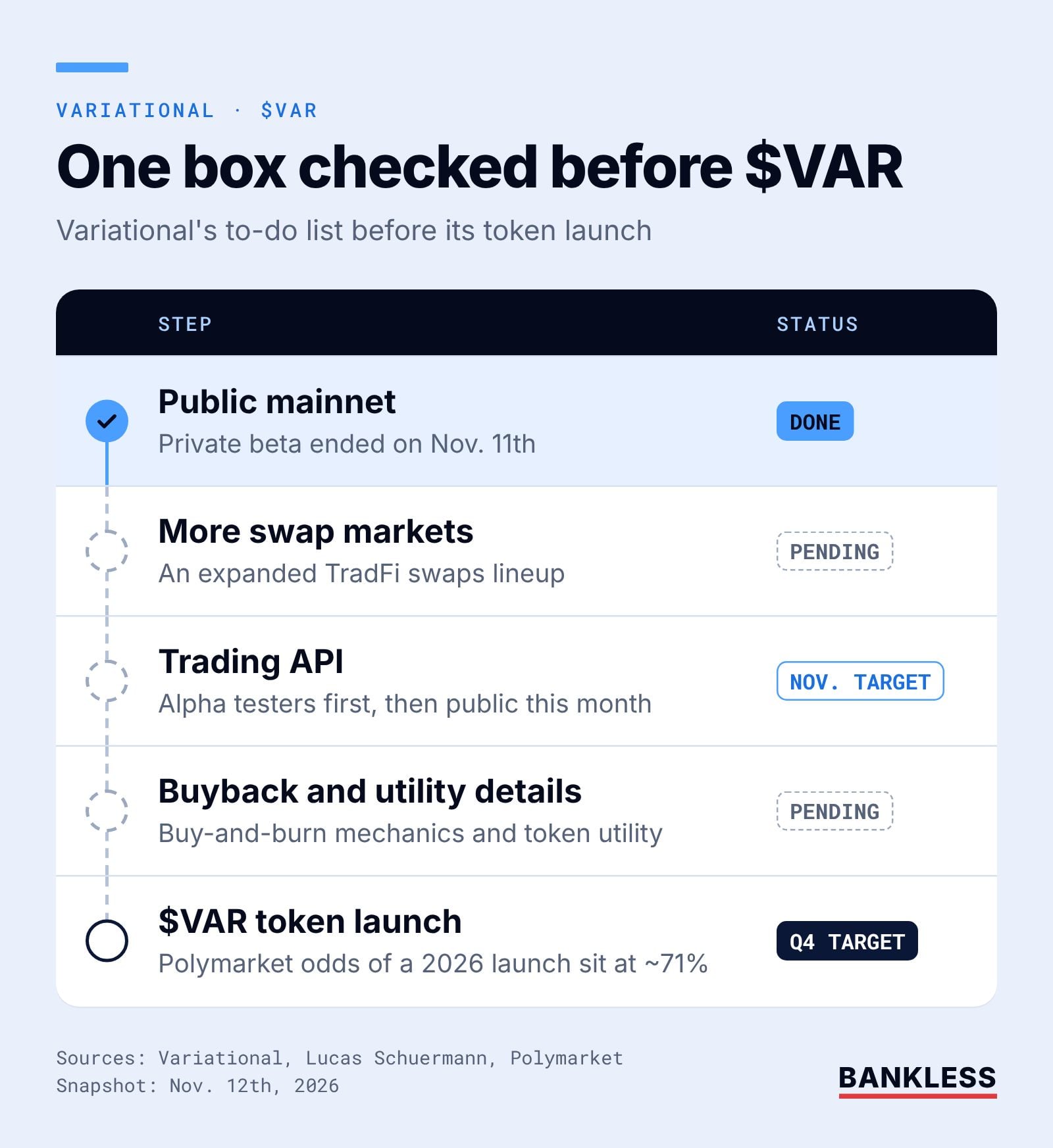
As reported on November 13, 2026, Variational had ended the private test of its Omni trading app and opened registration without invitation codes. The wider launch puts its single-market-maker model to a public test ahead of a planned $VAR token generation event (TGE) in the fourth quarter of 2026. The TGE had not yet taken place.
What Variational has proposed for $VAR
In a September 23 tokenomics post, Variational allocated 32% of $VAR’s total supply to a genesis airdrop for points holders. It also said it planned to use 100% of treasury revenue to buy back and burn $VAR. Those are a distribution allocation and a stated plan, not evidence that tokens have been distributed or buybacks have begun.
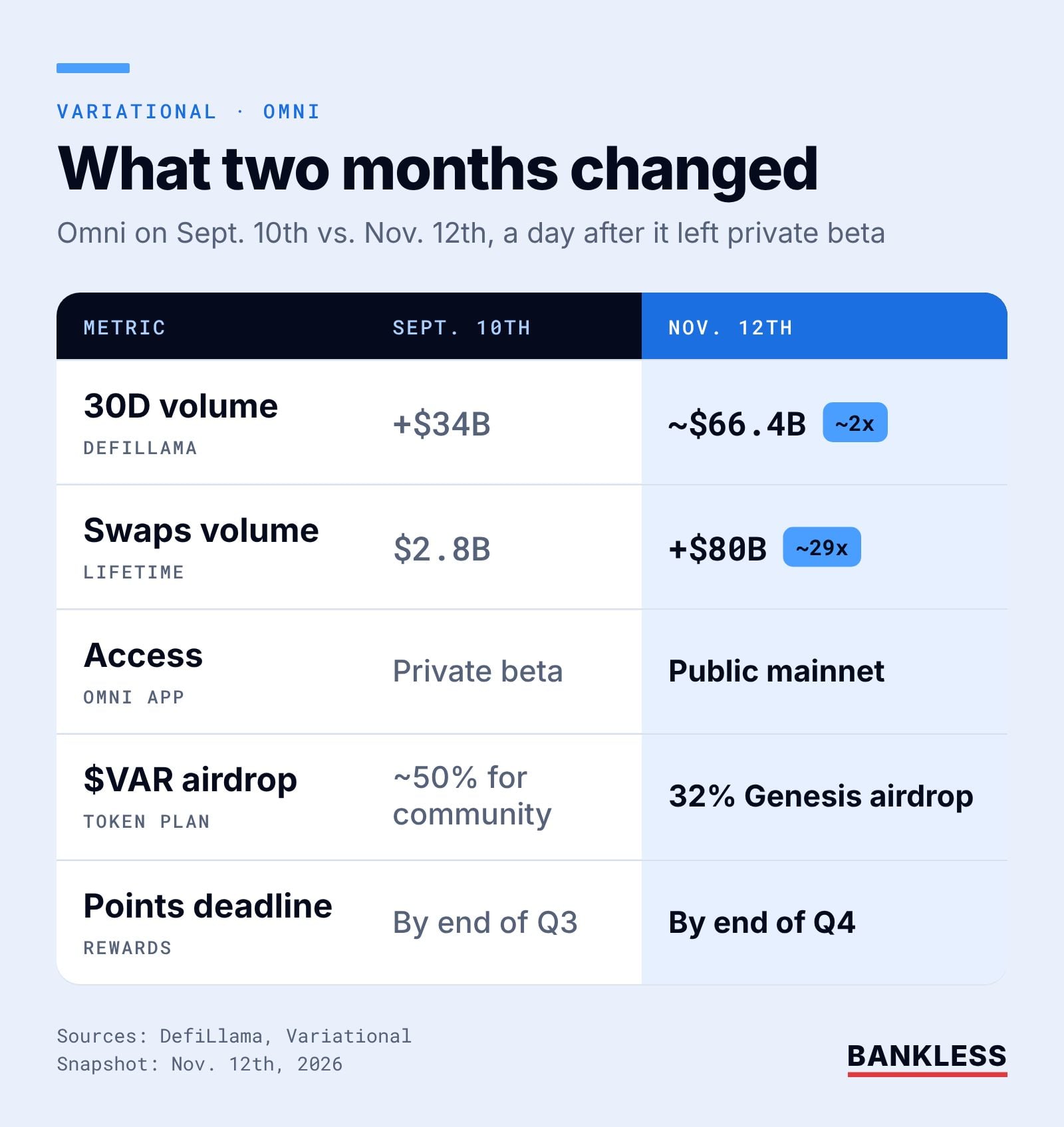
The points programme was continuing after its earlier third-quarter deadline. Its weekly allocation was fixed at 150,000 points, recently shared among approximately 32,000 accounts. Removing the invitation requirement could increase the number of accounts competing for that fixed weekly allocation; the source does not establish what any individual account will receive.
Variational said it was still on track for a 2026 TGE. CEO Lucas Schuermann said on November 4 that a trading API was available to a small group of early testers and was expected to open publicly later that month. At the time of reporting, Polymarket traders put the probability of a token launch before year-end at approximately 71%—a market estimate, not a confirmed launch date.
The revenue mechanism behind the buyback plan
Omni does not charge a separate trading fee. Users instead pay a bid–ask spread when receiving a quote from Omni Liquidity Provider (OLP), the platform’s sole market maker. The protocol currently takes 20% of OLP’s spread revenue. Variational reported approximately $1.05 million from that treasury share over the preceding two weeks. If its stated buyback-and-burn plan is implemented, the funding available through this mechanism will depend on OLP’s spread revenue; the two-week figure does not establish a future rate.
Omni uses requests for quotes rather than a public order book, and OLP hedges its exposure on other venues. Each user’s collateral sits in a separate on-chain settlement contract rather than with the market maker. That separation does not remove OLP counterparty risk: its documentation says profits users accrue after OLP becomes insolvent would be treated as unpayable bad debt. Outside observers also cannot currently audit OLP’s hedging book. Critics have questioned the lack of competing quotes from multiple market makers; Variational co-founder Edward Yu has argued that Omni must win users in a market with other perpetual-trading venues.
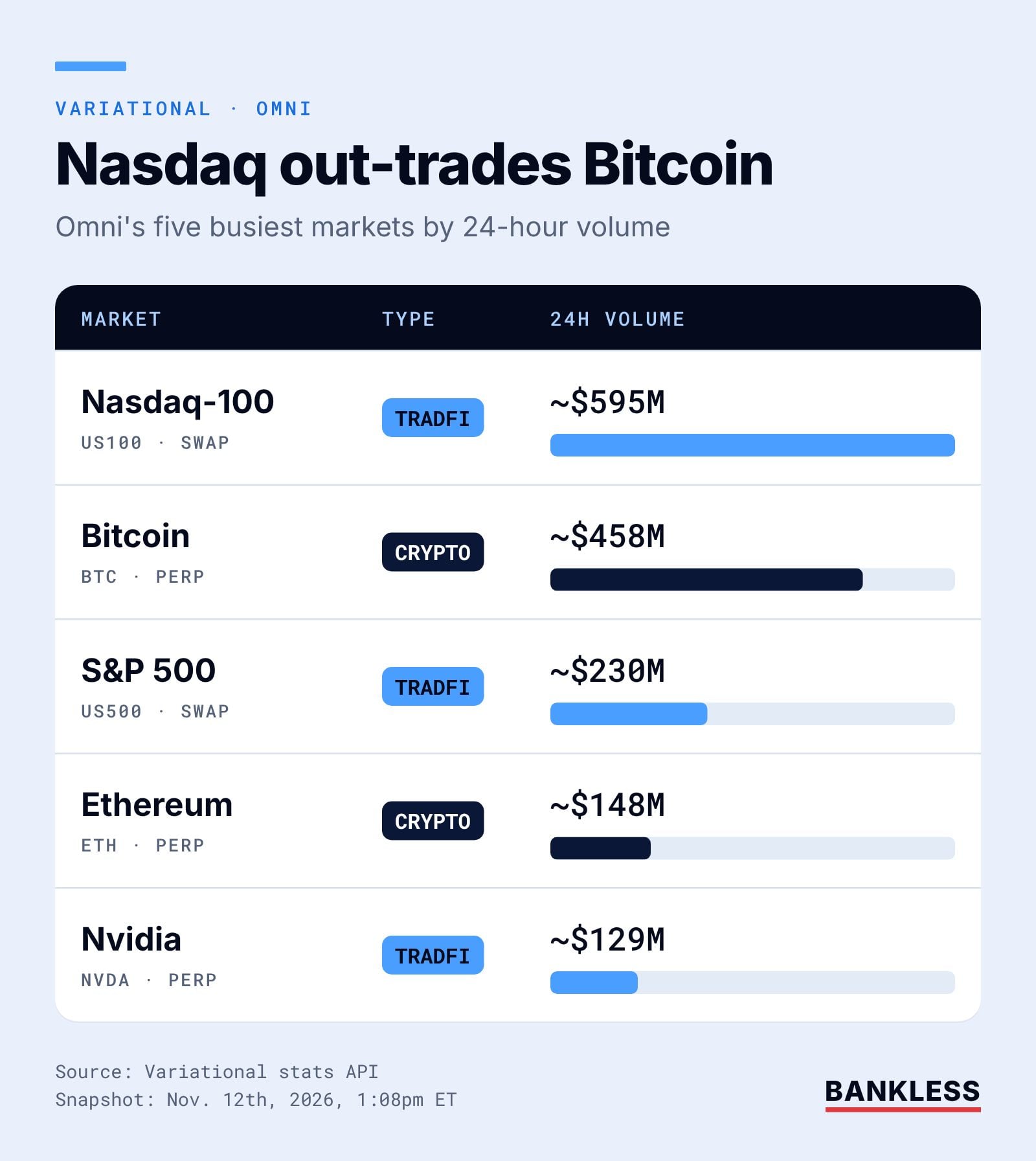
The scale of activity matters to the revenue mechanism, but volume alone does not determine treasury income. DefiLlama showed approximately $66.4 billion in 30-day volume as of the Thursday morning cited in the report, up from more than $34 billion cited on September 10. Variational said on November 10 that cumulative volume in Omni’s traditional-finance Swaps markets had exceeded $80 billion; those markets, including gold, oil and equity indices, accounted for more than 60% of Omni’s total trading volume at the time. U.S. and Canadian residents could not use Omni.
Public access is now in place, but the planned TGE, buyback details and token utility remained matters for Variational to deliver or clarify as of the November 13 report.