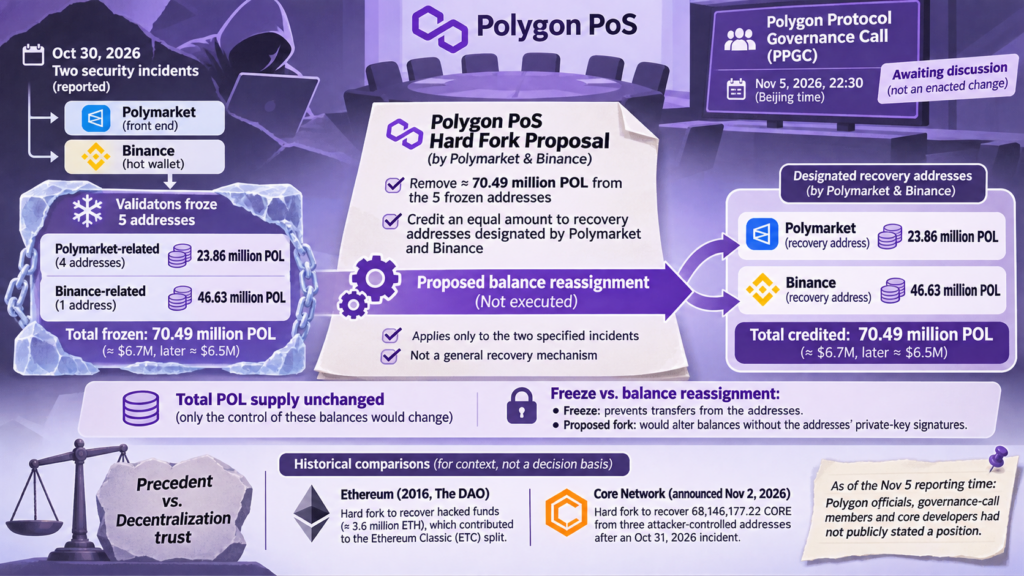
As reported on November 5, 2026, at 21:00 Beijing time, Polymarket and Binance had proposed a Polygon PoS hard fork to recover POL held at addresses linked to two reported security incidents. The proposal was awaiting discussion at a Polygon Protocol Governance Call scheduled for 22:30 that evening; it was not an enacted change at the time of reporting.
Under the proposal, the fork would remove approximately 70.49 million POL from five frozen addresses and credit an equal amount to recovery addresses designated by Polymarket and Binance. This would change who controls those balances, not POL’s total supply. The report gave the amount’s approximate value as $6.7 million at the outset and about $6.5 million later in the article.
The report traced the proposal to October 30 incidents involving Polymarket’s front end and a Binance hot wallet. It said Polygon validators froze four addresses associated with the Polymarket incident, holding 23.86 million POL, and one associated with the Binance incident, holding 46.63 million POL. According to the proposal, Polymarket had sought a response from the attackers without success, and the attackers had contacted validators offering cash in exchange for unfreezing addresses. Those accounts of the attackers’ conduct were claims reported from the proposal, not independently established facts.
A freeze and a balance reassignment have different consequences. The reported freeze prevented transfers from the addresses. The proposed fork would instead alter balances without the addresses’ private-key signatures. Polymarket and Binance said the action would apply only to the specified incidents and should not become a general recovery mechanism. The report also said both had already fully compensated affected users; it did not describe the proposal as a means of issuing new POL.
The original article argued that changing balances could set a troubling precedent and judged approval unlikely. That was its assessment, not a governance decision. It cited two historical comparisons: Ethereum’s 2016 hard fork following The DAO exploit, which contributed to the Ethereum Classic split, and Core Network’s announced November 2, 2026 hard fork to recover 68,146,177.22 CORE from three attacker-controlled addresses after an October 31 incident. Neither example established how Polygon would decide this proposal. As of the November 5 reporting time, the article said Polygon officials, governance-call members and core developers had not publicly stated a position.