Published context: This is a reading of a November 11, 2026 BlockBeats report that reprints research from Starkiller Capital on StablecoinX, the Nasdaq-listed ENA treasury vehicle trading as USDE. The figures below are those given in that report. They describe conditions as of that date, including a prior Friday close, not a later market.
StablecoinX is a digital-asset treasury company. Starkiller’s note, as carried by BlockBeats, says it holds about 20% of total ENA supply — the September balance of 3.029 billion ENA, which the company still held when the note was written. On the prior Friday the shares closed at $6.43. Each share was said to correspond to 125.48 ENA, worth $20.10. That is an mNAV of 0.32: about 32 cents of equity value per $1 of ENA, or a $155 million market cap against $485 million of tokens.
mNAV here is company market capitalization divided by the market value of the ENA held. Starkiller writes the share price as the ENA price, times ENA per share, times that multiple. A long USDE position paired with a short ENA position of the same dollar amount is meant to cancel the token’s price and leave the multiple. It is not a hedge of 125 ENA per share. If the multiple is unchanged, the stock and the token are described as moving one-for-one in percentage terms, so equal dollars are the hedge the note specifies.
Why a large discount used to match the supply rules
StablecoinX listed in June 2026 through a merger with the SPAC TLGY. Ethena positioned it as a public-market vehicle for ENA, following the pattern of bitcoin and ether treasury companies. A small infrastructure business was attached; the report says it did not matter for valuation, with revenue of $62,000 in the last two weeks of June. At the end of the second quarter the company had about $19 million of cash and about $18 million of liabilities. Starkiller’s practical conclusion is that, for valuation, the equity is a pile of ENA.
The firm also says it generally considers crypto treasury companies poor vehicles and largely unnecessary, and that USDE itself adds no real value to the ecosystem and is usually a bad way to hold beta — the discount to asset value is part of that evidence. The trade is a bet on the multiple anyway.
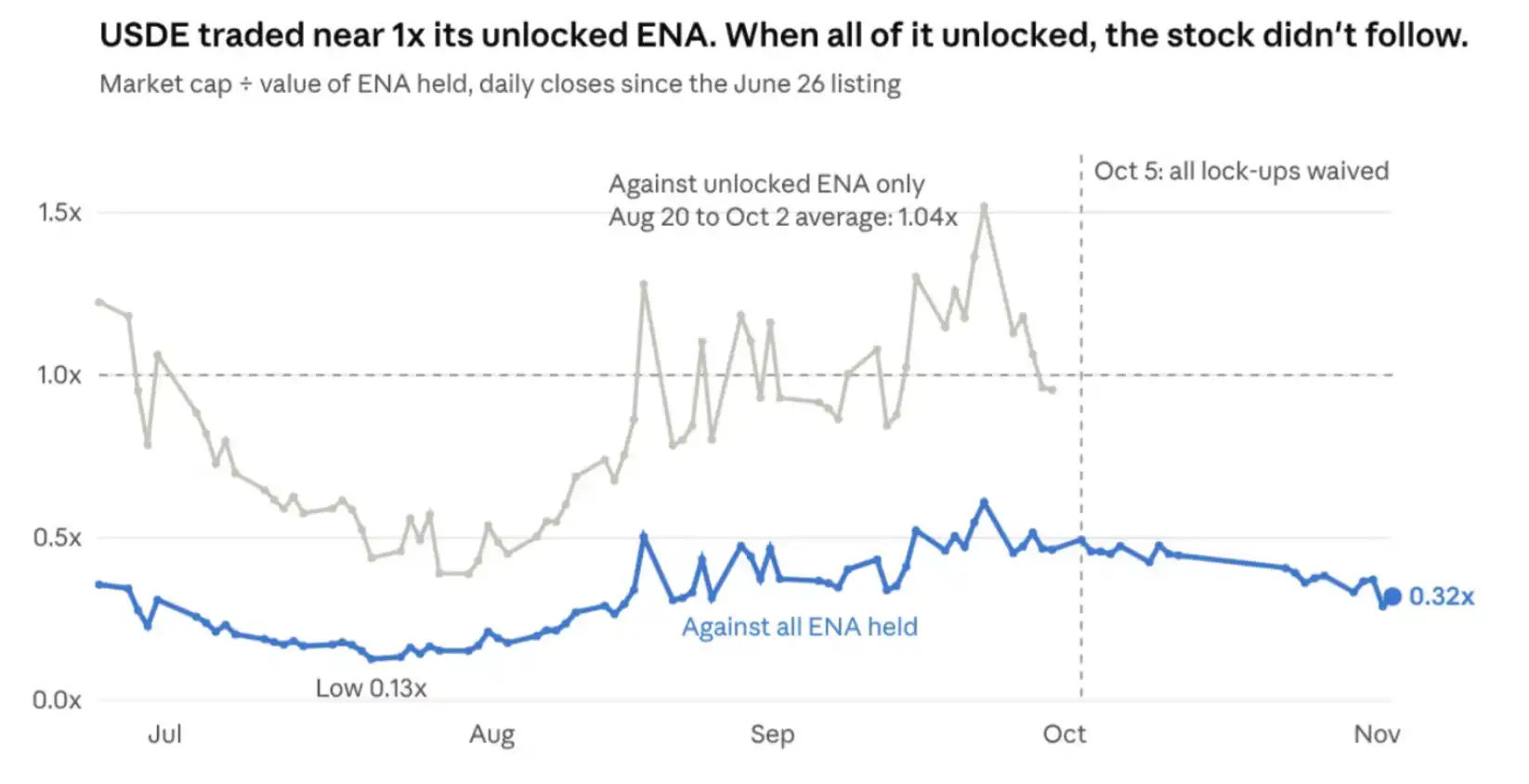
For most of the time after listing, the discount had a supply reason. Under the token purchase agreement, about half the ENA was to unlock over 48 months, with full unlock only in 2029, and each sale needed Ethena Foundation consent. As of October 4, 1.56 billion ENA were still locked. Starkiller says the market’s response was coherent: from late August to early October, measured only on unlocked ENA, the stock traded around 1x. Investors paid full value for tokens the company could actually use and assigned zero to the rest.
What the waiver changed, and what it did not
On September 14, Ethena and the Foundation signed a letter waiving all lock restrictions, effective October 5. Unlocked ENA value per share went from $14.82 to $30.28 overnight. The share price went from $14.15 to $14.96. If the market had kept marking USDE only on unlocked ENA, Starkiller says the stock should have roughly doubled. Instead the valuation multiple slid from 0.49x to 0.32x.
That slide sat on top of an earlier move. Before the waiver was approved, USDE’s mNAV had already risen from 0.15x to 0.61x — the market had treated an exemption as likely — and then fell hard to 0.32x. Starkiller’s own book, as described in BlockBeats’ editor’s note and in the research itself: the firm was in the trade from August 2026 at 0.18x (about 18 cents of market value per $1 of ENA), took profit on the accumulated stock around 0.60x, then rebuilt a larger position as the stock fell faster than ENA and the discount reopened at 32 cents per $1 of assets. The firm says it is publishing the work with its own interest in the position.
Selling tokens after the waiver still needs Foundation approval. The letter does pre-approve what it calls financing sales, and one use it lists is repurchasing stock under a Foundation-approved 10b5-1 plan. The letter also gives the Foundation the right to buy any ENA the company proposes to sell, so a sale used to fund buybacks could clear off-exchange rather than as open-market ENA supply.
Why the multiple widened after more tokens became usable
Starkiller’s account of October 2026 is a beta and microstructure story, not a change in the coins on the balance sheet. Bitcoin fell 7% and ENA fell 29%. In that tape, the note argues, investors were cutting crypto exposure rather than recomputing a small treasury’s asset value, and USDE was one of those exposures.
The stock fell harder than the token for reasons tied to who held it. Many holders had bought USDE in order to be long ENA inside a securities account, so leaving ENA meant selling USDE. The equity was also among their least liquid holdings: a $155 million market cap and about 1 million shares of daily Nasdaq volume, so cutting risk could gap the price. Short interest rose 78% to about 2.8 million shares, roughly 15% of the free float. None of that changed the 3.029 billion ENA. After October 5 those tokens could be used to fund buybacks. The discount Starkiller says it is willing to own is one that opened because equity holders were reducing exposure, not because the assets behind the shares changed.
The same link can run the other way. In August and September, as ENA rose, the multiple went from 0.15x to 0.61x as investors who treat USDE as a substitute for ENA bought it back. October reversed that flow. On this account, a recovery in the token would tend to lift the multiple again. That is an assumption about holder behavior, not a schedule.
The buyback arithmetic, and whose incentives it assumes
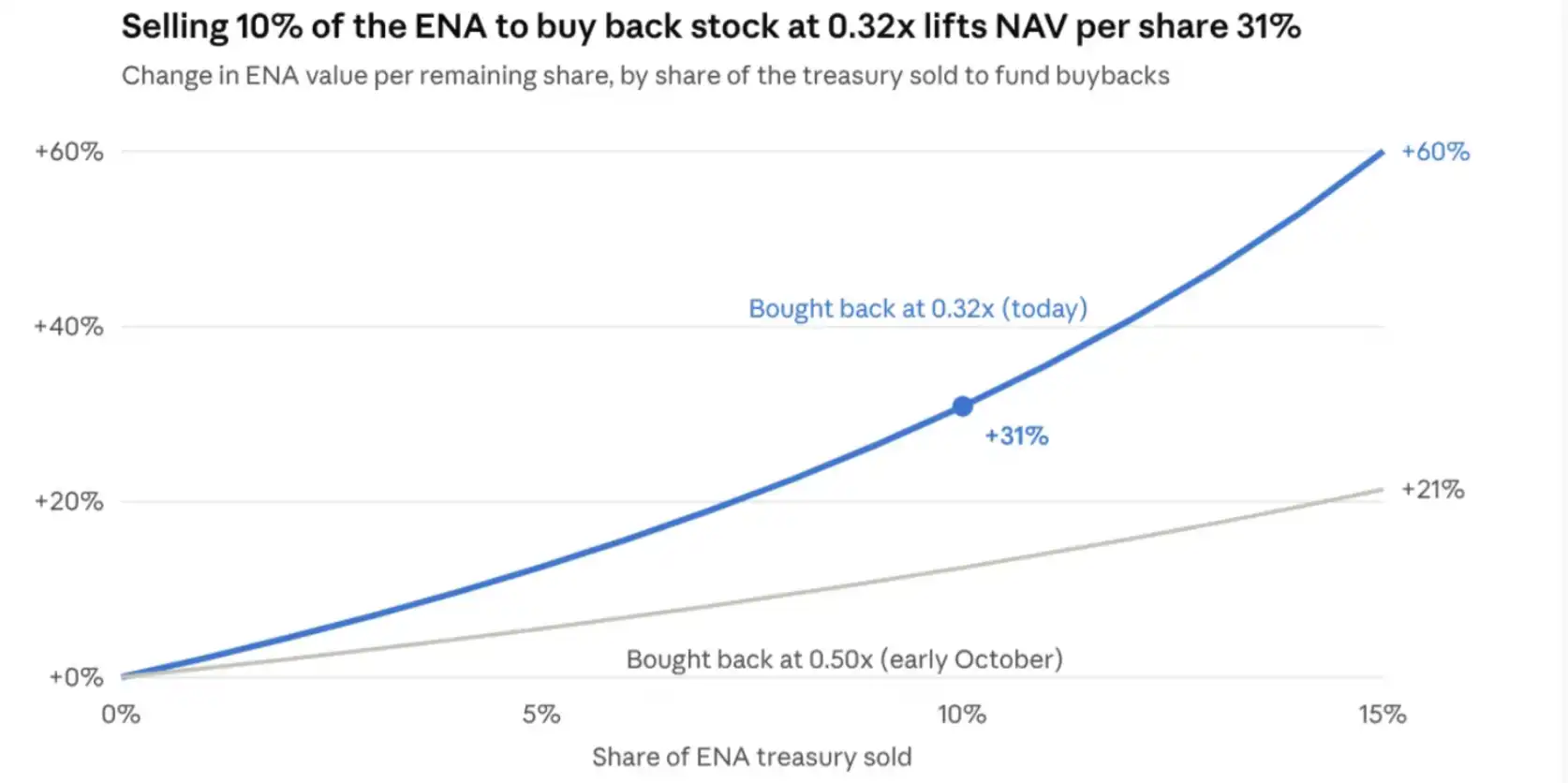
At 0.32x, Starkiller’s accretion example is: sell $1 of ENA to repurchase shares, retire equity that claims $3.13 of ENA, and leave $2.13 of asset value with the remaining holders. The company spends tokens, but the share count falls faster, so ENA per remaining share rises. At the prior Friday’s prices, the note says using one-third of the treasury would be enough to repurchase all outstanding Class A shares. That arithmetic is the stated result of a 0.32x multiple. It is not a forecast of how many tokens will be sold.
Whether anyone does it is an incentive claim, which Starkiller presents as its own view. The chief financial officer, in the second-quarter earnings release, called narrowing the gap between market cap and the value of assets held a priority. The company changed chief executive in September. Ethena was pitching USDe — the stablecoin, a different instrument from the USDE share — to users of BlackRock’s Aladdin platform, to Janus Henderson, and to Coinbase. Starkiller’s argument is that a listed stock representing ENA exposure, trading at about one-third of the token value it corresponds to, does not help those conversations, and that the Foundation did not have to sign a waiver that names stock buybacks but did sign it. If the Foundation takes the tokens itself, ENA holders in the open market would not have to absorb that sale.
The document named in the November 11 piece was still ahead: the third-quarter 10-Q, due no later than November 16, 2026, and described as the first quarterly filing after the waiver letter. What Starkiller said to look for was whether the company would publish a specific repurchase plan and how many shares it intended to buy. Nothing here adds what that filing later said.
Carry, rebalancing, and the returns Starkiller sketches
The note says ENA perpetual funding on Hyperliquid had been positive since the firm put the trade on, including the prior six weeks, so over that window the short was a source of funding income rather than a cost. If the long market value grows faster than the short notional, the package becomes net long ENA unless it is rebalanced. Starkiller says that from August to October it let some of that beta ride, using gains from the multiple, and made money — and that doing so requires timing.
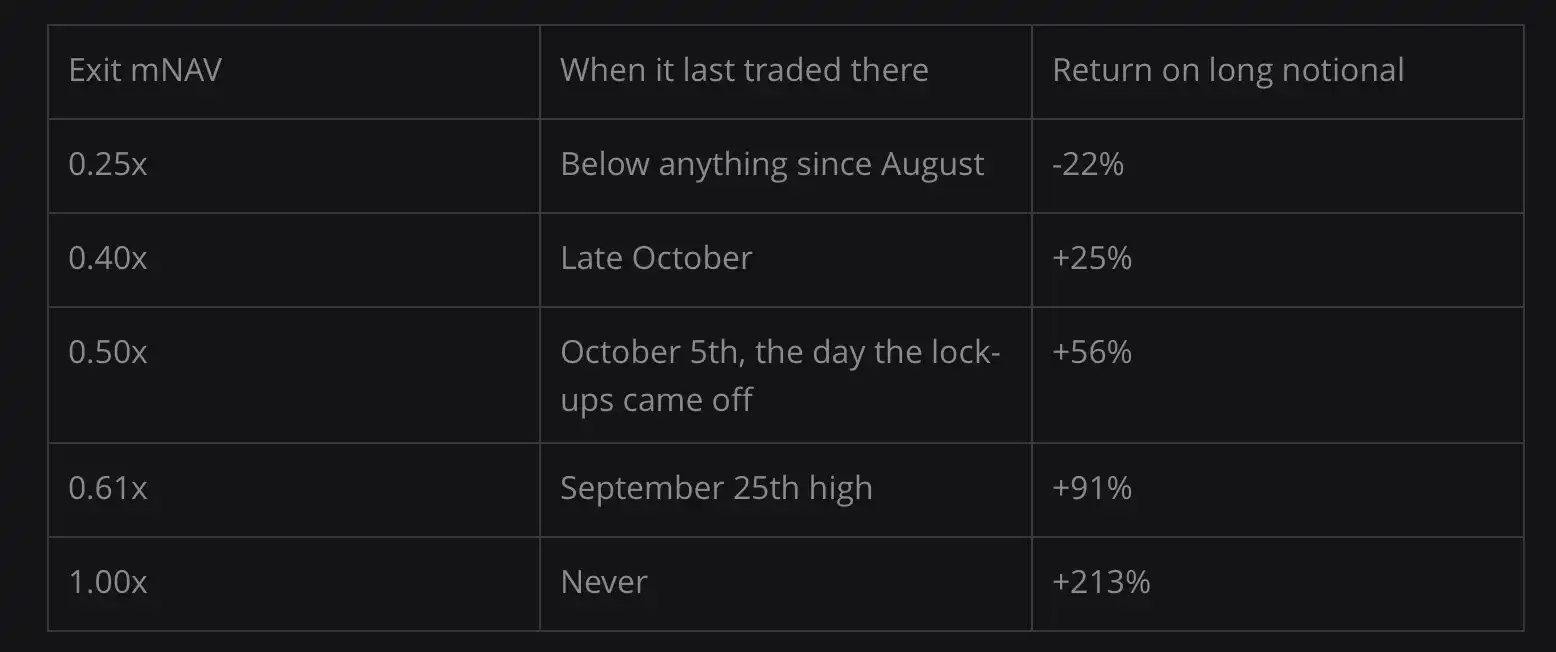
Its return sketches assume an unchanged ENA price and are stated before funding and trading costs. Gross exposure on the two sides is twice the long notional. The note says that even without a return to 1x, getting back only to the level on the day the lock was lifted would be a 56% gain on the long side. It also says the stock should eventually trade at a 0.7x mNAV, because other treasury companies trade around that level, including some that still have large token balances locked. Those are Starkiller’s comparisons and targets, not outcomes. Separately, the firm says that holding the package was earning about 5%, which it describes as half the positive funding rate received on the ENA short, and that — because the timing is hard to call — the more reasonable approach is to keep the position and wait for a catalyst.
BlockBeats’ editor states the dependency directly: whether the trade makes money again depends on the stock outperforming ENA. A buyback may narrow the discount. Shareholders cannot force an exit at asset value.
What can keep 0.32x in place, or push it lower
Nothing in the structure forces the discount to close. There is no redemption mechanism. Starkiller uses GBTC as a warning rather than as a path USDE must follow: for most of 2022, bitcoin could be bought through Grayscale at a large discount, sometimes beyond 40%, and that discount lasted about two years until the trust converted to an ETF. Buyers who held the discount through conversion made money. The discount itself was not on a clock.
The Foundation controls the exit. Token sales need its consent. It designates one of three investment-committee seats and controls the Class B vote. If it never approves a buyback, the discount can remain. The waiver names a path; it does not require that path to be used.
Equity supply can also arrive on a rally. An S-1 registers about 12.7 million shares for resale by existing holders, more than half of the Class A total, so those holders can sell if the price rises. Warrants add dilution on the way up: 11.5 million listed warrants with an $11.50 strike, and about 7.6 million sponsor warrants with strikes of $11.50 and $15. They were out of the money at the prices in the note, and they limit how far a recovery can go before new shares appear.
The multiple had already been lower without a company-specific failure. It listed at 0.36x and reached a low of 0.13x in July. In October it still fell from 0.49x to 0.32x. A broader crypto decline could also lead investors to treat the ENA inside USDE as unrealizable and push mNAV back down. The multiple has tracked crypto beta in both directions, so that link is a risk to the residual as well as a possible support.
Starkiller’s close, as of November 11: for three straight months the market priced the stock on ENA the company could actually sell; then all of the ENA became sellable and a pre-cleared buyback path appeared, under which 32 cents of equity could retire a claim on $1 of assets, and the market marked the shares lower still. The firm said that at 0.32x it was more constructive than at its August entry. That is a position-holder’s conclusion. The mechanism increases ENA per remaining share only if the Foundation allows a sale and the company retires shares below asset value. It does not give a passive holder a contractual claim on that accretion, and a low multiple is not evidence that the gap must close.
Original report: BlockBeats, November 11, 2026, reprinting Starkiller Capital’s note on USDE and ENA.